
Chief MD, Gangnam
Duk-ha Kim
The trust our patients have placed in this clinic was built on conviction and principle. We intend to hold to both, unchanged, through the next hundred years.
 Seoul
Seoul

Product guide — which of the two Juvelook products, and which evidence belongs to it
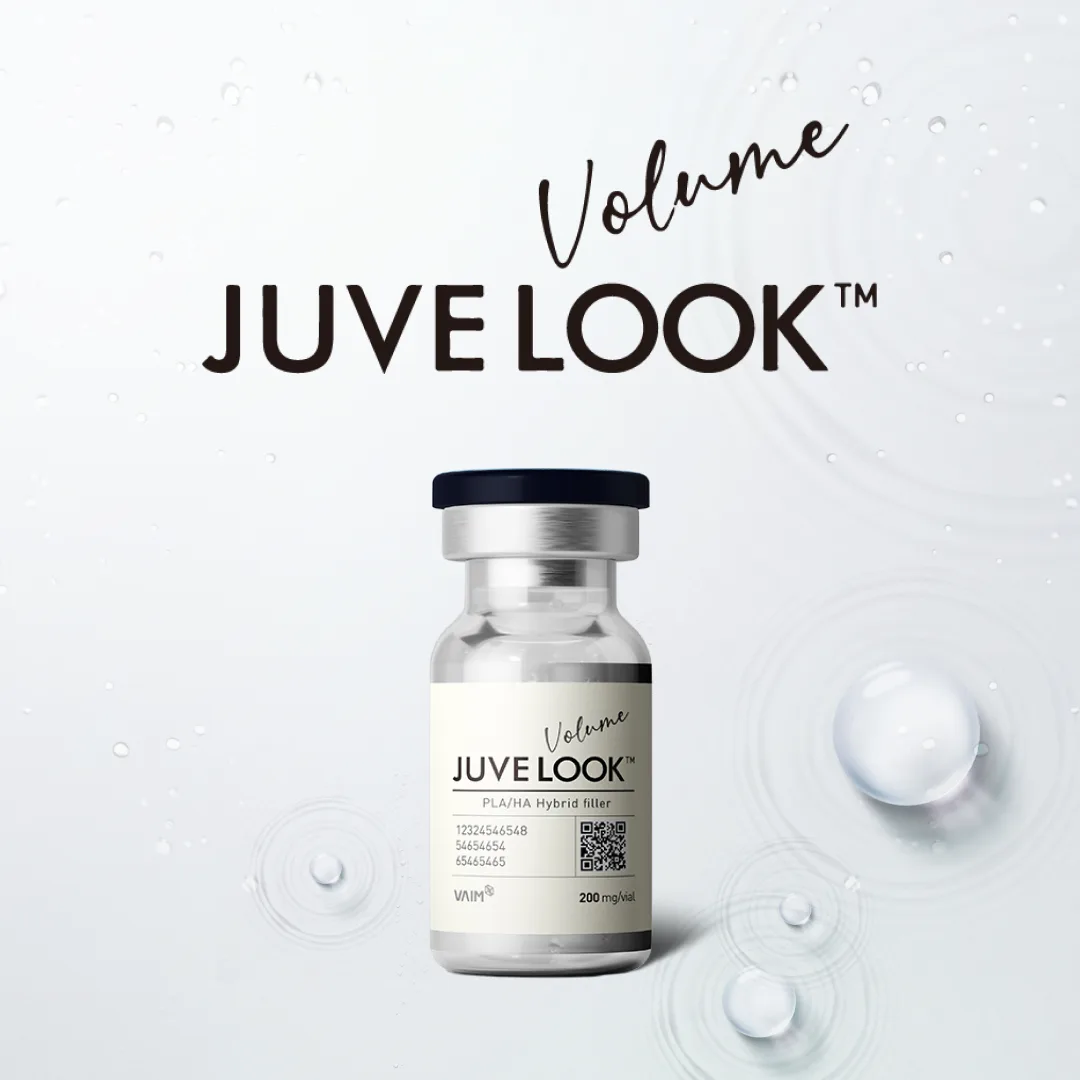
Juvelook Volume is a separate product from standard Juvelook, not a larger syringe of the same thing: the manufacturer, VAIM Co., Ltd., lists Volume as PDLLA 170 mg with hyaluronic acid 30 mg, while standard Juvelook is listed as PDLLA 42.5 mg with hyaluronic acid 7.5 mg — roughly a quarter of each figure — and the two carry different indication wording. That separation decides what may honestly be said here, because the published case series most often quoted in this area studied the standard product, and no clinical study of Volume itself was verified for this page. The same care applies across borders: what is sold under this brand on the United States site is a topical serum carrying a cosmetic registration and marked not intended for injection, which is a different category of product from the injectable this page is about.
It is a separate injectable product sold under the same brand name, which is why the first useful thing anyone can do with this page is stop treating the two as one item. Both are listed by VAIM Co., Ltd., a Korean manufacturer with a Seoul address on Yeongdong-daero and a research site in Daejeon, and both combine poly-D,L-lactic acid with hyaluronic acid. From there they diverge: the stated amounts in the vial differ several-fold, the manufacturer lists them for different things, and the published work that gets quoted in consultations was done on one of them and not the other. Two limits belong with that summary. The footer of the official product site carries the words For export only, which is a manufacturer notation and not by itself a statement about whether the product is approved for domestic distribution in any particular country. And a brand name is not a specification: everything below describes what the manufacturer states about each item, which is a different kind of claim from what a regulator has assessed or a trial has measured.

About fourfold on both listed ingredients, which is the single fact that makes this a separate page rather than a paragraph on another one. The manufacturer lists JUVELOOK Volume as PDLLA 170 mg with hyaluronic acid 30 mg, and standard JUVELOOK as PDLLA 42.5 mg with hyaluronic acid 7.5 mg. The ratio between the two polymer figures and between the two hyaluronic acid figures is close to four in each case, so this is not a variant with a slightly heavier fill but a different formulation carrying the same family name. What that difference does not do is settle anything about an individual outcome. A stated amount in a vial is an input, and between the vial and a face sit dilution, the volume actually placed, how many vials a session uses, which plane the material is placed in, and the person being treated — none of which a number on a box describes. Read the figure as an identity check, the thing that tells you which product you are being quoted for, rather than as a measure of how much anything will change.
Different lists, overlapping at exactly one item. For JUVELOOK Volume the manufacturer names acne scars, forehead, temples, nasolabial folds and facial sagging. For standard JUVELOOK it names skin rejuvenation, tear trough and acne scars. Acne scars appear on both; everything else is specific to one or the other, and the Volume list is weighted towards areas that are described in terms of contour and support rather than surface quality. Three qualifications keep this usable. This wording comes from the manufacturer describing its own products, which is not the same thing as an indication assessed and granted by a national regulator, and no such national indication text was verified for this page. A listed area is not a recommendation that any individual should be treated there, since area selection is a clinical judgement made in person after examination. And a shared entry such as acne scars does not make the two products interchangeable for it, because the formulations behind that shared word are the ones set out above.
It means it is being placed in a category that the literature defines by mechanism rather than by immediate physical fill. A 2025 systematic review in Aesthetic Plastic Surgery, conducted to PRISMA method, screened 1,237 records and included 29; it treats poly-L-lactic acid, calcium hydroxylapatite and polycaprolactone as biostimulators with a role in collagen induction, and it sets that group apart from hyaluronic acid fillers. That framing is what transfers to this page, and it transfers with edges. The review names PLLA rather than the poly-D,L form in this product, so it supports the category discussion and not a product-level claim about this vial. It reports adverse events across the whole class rather than for any one item: erythema, bruising and nodules in 15 to 30 per cent, with granuloma and vascular occlusion described as rare. Those percentages belong to the class of biostimulators as pooled by the review and should never be quoted as this product having that rate, because no such product-specific figure was verified here.
Sources: Aesthetic Plast Surg 2025 — systematic review of biostimulators
None was verified for this page, and that sentence is written deliberately rather than as a hedge. The case series that circulates in consultations about this brand was carried out on the standard product, and a class-level systematic review describes a category of biostimulators without testing this formulation. So the honest position is that claims made specifically about Volume currently rest on the manufacturer listing plus the general category discussion, and not on a trial of this product. Three things follow. Absence of a verified study is not a finding that the product does not work — it is a statement about what can be cited, and the two are easy to blur. A study carried out on a formulation with roughly a quarter of the stated polymer and hyaluronic acid content is not automatically transferable to one with four times as much, which is precisely why the concentration difference matters beyond bookkeeping. And if a clinic quotes a study while discussing Volume, the useful question is simply which product the study used, because that one question resolves most of the confusion on this page.
Sources: J Craniofac Surg 2026 — Juvelook case seriesAesthetic Plast Surg 2025 — systematic review of biostimulators
It covers standard Juvelook in twenty people, and it stops well short of what it is usually asked to support. Published in the Journal of Craniofacial Surgery in 2026, it is a prospective case series: non-randomised, with no control group, and with twenty participants in total. The protocol described dilution in 6 mL, 1 mL injected per side, three sessions spaced one month apart, and assessment three months after the final session. Improvement on the Global Aesthetic Improvement Scale was reported in 85 per cent, and no nodules or granulomas were observed. Each of those numbers carries its design with it. With no control group, change over the study period cannot be separated from other factors acting at the same time. With twenty participants followed for three months after the last session, an event that is uncommon has plenty of room to go unobserved, so zero nodules observed is not the same as nodules ruled out. And the study used the standard product, so the protocol it describes — the dilution, the volume per side, the spacing — is a description of what was done in that study rather than a schedule that transfers to Volume.
A topical serum, which is a different category of product from the injectable this page describes, and the distinction is worth holding onto because the two share a brand. The United States site sells the product as a serum and lists FDA MoCRA #53-670426-700897 — a cosmetic listing under the Modernization of Cosmetics Regulation Act, which is a registration of a cosmetic product and not a medical device clearance or approval — and it states that the item is for professional topical use and not intended for injection. Read plainly, that means a United States page, a United States registration number or a bottle bought there tells you nothing about the injectable, and a cosmetic registration number should never be presented as regulatory approval of an injection. No United States marketing authorisation for an injectable under this brand was verified for this page. The Korean side is a separate question and is left open here on purpose: the For export only notation on the manufacturer site is a manufacturer notation, it does not by itself state whether the product is approved for domestic distribution, and no national listing status was verified for this page — absent from this page, not denied.
Sources: JUVELOOK USA — topical serum product pageVAIM — JUVELOOK official product site
The only measured timepoint across the sources on this page belongs to the case series on the standard product: the protocol ran three sessions one month apart and assessed outcome three months after the final session, at which point 85 per cent of the twenty participants showed improvement on the Global Aesthetic Improvement Scale. That is a single assessment at one point after the sessions ended, not a curve showing how the result changes from there, and the series carried no control group, so its own design limits apply here as much as to the improvement figure itself. It also describes the standard product, not Volume, and the two differ by roughly fourfold on both stated ingredient amounts, which is exactly the gap already flagged as a reason results do not transfer between them. The systematic review on biostimulators frames the category by mechanism — a role in collagen induction rather than an immediate physical fill — which is a description of how this class of product is understood to act, not a stated timeline for either product discussed here. If a duration is quoted during a consultation, ask whether it comes from that case series, from the manufacturer, or from clinical experience, and whether it is being applied to standard Juvelook or to Volume.
Sources: J Craniofac Surg 2026 — Juvelook case seriesAesthetic Plast Surg 2025 — systematic review of biostimulators
Because the possibility is taken seriously enough in the clinical literature that guidance exists for handling it. A 2025 paper in the Journal of Cosmetic Dermatology sets out the diagnosis and management of nodules associated with PDLLA. This page does not quote its content, because its text was not obtained, and the point being made is narrower than a citation of findings would be: the existence of a diagnosis-and-management paper is itself evidence that this is a recognised clinical topic rather than a hypothetical raised by sceptics. Two other pieces of context sit alongside it, each with its own scope. The systematic review of biostimulators lists nodules among adverse events across that class at 15 to 30 per cent together with erythema and bruising, with granuloma and vascular occlusion described as rare — a pooled class figure, not a figure for this product. And the case series on the standard product observed no nodules or granulomas, which is a real observation in twenty people over three months rather than a demonstration that they do not occur. Nothing here is a reason to avoid a consultation; it is a reason to have the aftercare and contact route settled before the appointment.
Sources: J Cosmet Dermatol 2025 — PDLLA nodule diagnosis and managementAesthetic Plast Surg 2025 — systematic review of biostimulatorsJ Craniofac Surg 2026 — Juvelook case series
By reading the carton and the vial rather than accepting a spoken name, because two products under one brand is exactly the situation a verbal product name cannot resolve. Ask to see the packaging before anything is opened, and check the product name exactly as printed — whether the word Volume appears — together with the stated PDLLA and hyaluronic acid amounts, which should read 170 mg and 30 mg for Volume and 42.5 mg and 7.5 mg for the standard item. Confirm the manufacturer name, the lot number and the expiry date, and ask how the quote is counted: per vial, and how many vials a session uses. Then ask what will be done with the vial, since dilution volume and the amount placed per area are decided by the clinician and are not printed on the box. If what you are shown does not match what was described when you booked, that is a question to raise before the procedure rather than after, and it is a reasonable question to ask in any clinic.
Settle identity, evidence and aftercare, in that order, and settle them before any amount is agreed. The list below is deliberately about documentation rather than about results, because results are an in-person clinical judgement and none of the sources cited here addresses any individual case.
Sources: VAIM — JUVELOOK official product siteJ Craniofac Surg 2026 — Juvelook case series
This table separates items that share a brand name. It is not a ranking and not an efficacy comparison: composition and indication wording are the manufacturer describing its own products, the evidence column states which document covers which item, and no row states what is stocked or performed at any particular clinic.
| Item | Stated composition | What the manufacturer lists it for | Which evidence attaches to it |
|---|---|---|---|
| JUVELOOK Volume — injectable | PDLLA 170 mg with hyaluronic acid 30 mg | Acne scars, forehead, temples, nasolabial folds, facial sagging | No clinical study of this product was verified for this page; what applies is the class-level discussion of biostimulators and the manufacturer listing |
| Standard JUVELOOK — injectable | PDLLA 42.5 mg with hyaluronic acid 7.5 mg — roughly a quarter of each figure above | Skin rejuvenation, tear trough, acne scars | The 2026 case series in the Journal of Craniofacial Surgery: 20 people, no control group, three sessions a month apart, assessed three months after the final session |
| The product sold under this brand in the United States | A topical serum rather than an injectable; the site lists FDA MoCRA #53-670426-700897, a cosmetic registration and not a device clearance | Stated as for professional topical use and not intended for injection | Nothing on the injectable pages transfers to it, and its cosmetic registration is not an authorisation of any injection |
| Biostimulators as a class, set against hyaluronic acid fillers | The 2025 systematic review groups poly-L-lactic acid, calcium hydroxylapatite and polycaprolactone, and separates that group from hyaluronic acid fillers | Described by a role in collagen induction rather than by immediate physical fill | PRISMA review of 1,237 records screened and 29 included; erythema, bruising and nodules reported in 15 to 30 per cent across the class, with granuloma and vascular occlusion described as rare |
Composition and indication wording in this table are taken from the manufacturer describing its own products and are not statements of national regulatory approval; no such national listing was verified for this page in either direction. The 15 to 30 per cent figure belongs to the pooled class of biostimulators in the cited review and is not a rate for any product named here. Nothing in this table is a recommendation to have or to avoid a procedure, and suitability is decided in person by a clinician.
Sources: VAIM — JUVELOOK official product siteJUVELOOK USA — topical serum product pageJ Craniofac Surg 2026 — Juvelook case seriesAesthetic Plast Surg 2025 — systematic review of biostimulators
Care is provided by the medical team at the branch you select. These clinicians lead the three branches linked from this guide; confirm the doctor assigned to your visit with that branch.
Chief MD, Gangnam
The trust our patients have placed in this clinic was built on conviction and principle. We intend to hold to both, unchanged, through the next hundred years.

Chief MD, Myeongdong
I want to be thinking about how the patient feels right up to the last moment of the procedure.

Chief MD, Hongdae
I will give my best with the attentiveness to catch even the smallest change.
Listed branch medical team — not a medical-review byline for this article.
A specific injectable product from VAIM Co., Ltd. that is listed separately from standard Juvelook, not a larger dose of the same item. The manufacturer states PDLLA 170 mg with hyaluronic acid 30 mg for Volume and PDLLA 42.5 mg with hyaluronic acid 7.5 mg for the standard product, and lists the two for different things. Treating the word Volume as a size option is the single most common misreading of this brand, and it is the reason a quote should always be tied to the printed carton.
Because the vial is a combination: a polymer, PDLLA, listed alongside hyaluronic acid, and the manufacturer states both amounts for each product. The two components are described differently in the literature — hyaluronic acid is the material a conventional filler is made of, while polymers of this family are grouped as biostimulators in the 2025 systematic review cited here. For identifying which product you are being offered, both numbers matter, since it is the pair 170 and 30 against the pair 42.5 and 7.5 that distinguishes the two items.
The cited review defines the difference by mechanism: it groups poly-L-lactic acid, calcium hydroxylapatite and polycaprolactone as biostimulators with a role in collagen induction and sets them apart from hyaluronic acid fillers, which are discussed in terms of the material placed. That is a categorical description drawn from a review of 29 included studies, not a measurement of what happens in an individual, and the review names PLLA rather than the poly-D,L form used in this product — so it supports how the category is described rather than a claim about this vial.
Two things, and both are documentary rather than promissory: the stated amounts differ by roughly fourfold, and the manufacturer lists them for different areas. Volume is listed at PDLLA 170 mg with hyaluronic acid 30 mg for acne scars, forehead, temples, nasolabial folds and facial sagging; the standard product is listed at PDLLA 42.5 mg with hyaluronic acid 7.5 mg for skin rejuvenation, tear trough and acne scars. Acne scars is the only entry they share. Which is appropriate for a given person is a clinical judgement made in person, and this page does not make it.
They are placed in different categories by the literature rather than being two brands of one thing. The 2025 systematic review treats polymer and calcium-based products as biostimulators defined by a role in collagen induction and separates them from hyaluronic acid fillers. The practical consequences are worth asking about directly at consultation: the two categories are discussed with different mechanisms, different expected timelines and different adverse-event profiles, and the review reports erythema, bruising and nodules in 15 to 30 per cent across the biostimulator class as a whole rather than for any single product.
No. What the United States site sells under this brand is a topical serum, and it states the product is for professional topical use and not intended for injection. Its listing shows FDA MoCRA #53-670426-700897, which is a cosmetic registration under the Modernization of Cosmetics Regulation Act rather than a medical device clearance or approval. So the serum and the injectable are separate categories of product that happen to share a brand, and a registration number belonging to the serum says nothing about the injectable. No United States marketing authorisation for an injectable under this brand was verified for this page.
No source verified for this page reports pain scores for either product, so no comparison can honestly be offered. What can be said is that a stated amount in a vial is not a measure of sensation: what a person feels during an injection is influenced by the area treated, the depth and technique used, the number of entry points, any comfort measures the clinic offers and individual sensitivity, none of which is described by a number on a box. Ask the clinic to walk through what will physically happen and what comfort measures are available before booking.
Ask for the clinic’s own aftercare instructions and an urgent contact route before the appointment, since those are specific to the procedure performed and this page cannot supply them. For context, the cited systematic review lists erythema, bruising and nodules among adverse events across the biostimulator class at 15 to 30 per cent, with granuloma and vascular occlusion described as rare — class figures, not figures for this product. General post-procedure guidance applies: contact the clinic promptly for spreading redness or warmth, swelling that increases rather than settles, pain that builds, a new lump, blistering, drainage, or fever and chills, and seek emergency care for sudden severe pain, skin colour change or visual symptoms.
That cannot be answered from the sources cited here, because no clinical study of Volume itself was verified for this page. The three sessions one month apart that circulate in discussions of this brand come from the 2026 case series, which used the standard product in twenty people, with dilution in 6 mL and 1 mL per side, and assessed three months after the final session. That is a description of what one uncontrolled study did with a different formulation, not a schedule for Volume, and any plan should be set by the treating clinician rather than transferred from a study of another product.
Suitability and exclusion are in-person judgements that cannot be settled from a page, and none of the sources cited here addresses candidacy. What you can do is give the clinician the information the decision needs: any previous injectable treatment in the same area and what product was used, any history of nodules, lumps or delayed reactions after an injectable, any autoimmune or inflammatory condition, active infection or acne lesions in the intended area, any bleeding tendency or medication affecting bleeding, allergies, pregnancy or breastfeeding, and any planned dental or surgical work. Ask specifically what the clinician considers a reason not to proceed.
For the class as a whole, the 2025 systematic review reports erythema, bruising and nodules in 15 to 30 per cent, and describes granuloma and vascular occlusion as rare. Those are pooled figures across poly-L-lactic acid, calcium hydroxylapatite and polycaprolactone products in the included studies, and they must not be quoted as the rate for Volume, for which no such figure was verified. Separately, a 2025 paper in the Journal of Cosmetic Dermatology sets out diagnosis and management of PDLLA nodules; its content is not quoted here because the text was not obtained, but its existence shows the topic is a recognised clinical one.
This page does not claim an approval in either direction, and the reason is that the two facts available point in different directions. In the United States, what is sold under this brand is a topical serum with a cosmetic registration and an explicit statement that it is not intended for injection, which is not an authorisation of any injectable; no United States marketing authorisation for an injectable under this brand was verified here. For Korea, the manufacturer site footer carries the words For export only, which is a manufacturer notation and does not by itself state whether the product is approved for domestic distribution. Ask the clinic what regulatory status applies to the exact product it is proposing.
Match the product before comparing any amount, because two quotes using the word Juvelook may not be for the same item. For each quote establish which product is named on the carton, whether the word Volume appears and what the stated PDLLA and hyaluronic acid amounts are, whether the amount quoted is per vial or per session and how many vials a session uses, how many visits the quote covers and over what period, and whether consultation, aftercare and follow-up visits are included or billed separately. Without the product identified, comparing amounts compares nothing.
That is a clinical judgement made in person, and the sources cited here do not address candidacy at all — they address composition, indication wording, the class the product sits in, and how far the published work reaches. What follows from them is a sequence rather than a verdict: confirm which of the two products is being proposed, note that the manufacturer lists Volume for acne scars, forehead, temples, nasolabial folds and facial sagging while the standard product is listed differently, register that no study of Volume itself was verified here, and let a clinician who has examined you decide whether it is appropriate at all.
We started in Gangnam in 2006 and the network now runs 17 branches across Korea. The line we work to is skin transformation woven into everyday life — care you can keep up with, rather than one dramatic change.
Free Consultation
There is no inquiry form on this page. Once you have picked a branch above, open that branch’s site or the official reservation center and choose a time yourself.