
Chief MD, Gangnam
Duk-ha Kim
The trust our patients have placed in this clinic was built on conviction and principle. We intend to hold to both, unchanged, through the next hundred years.
 Seoul
Seoul

Collagen tissue-bulking injectable, stated-use guide
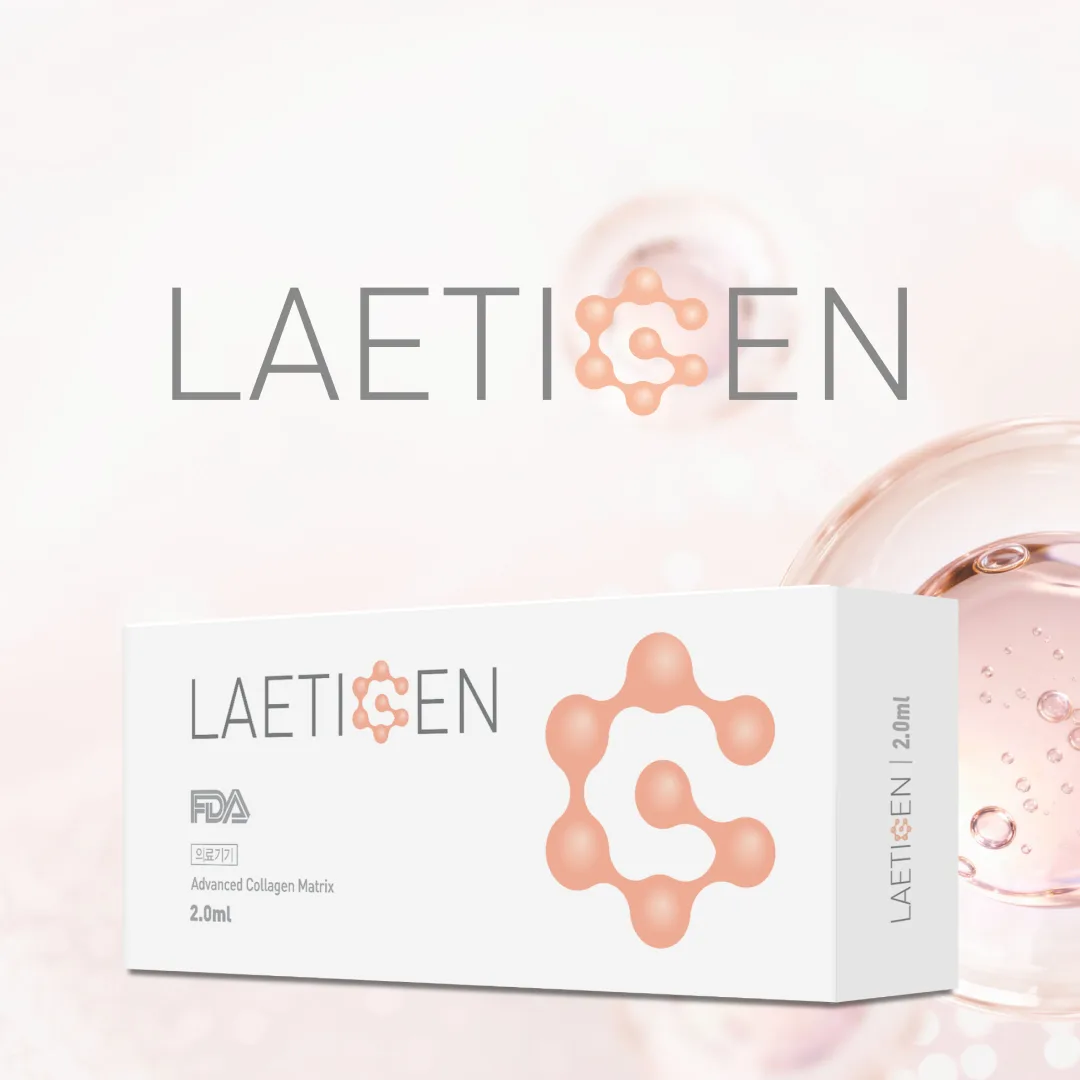
Laetigen is a collagen-based injectable manufactured by Dimed and distributed in Korea by Pharvis Korea. Its main ingredient is Type I collagen, and the product record states it is used during surgical or medical procedures to supplement deficient or damaged ligaments, tendons, muscles, or fascia. The collagen is porcine-derived, and the one peer-reviewed study tied to this product was conducted in cells and mice, not in human patients.
Laetigen is a collagen-based injectable manufactured by Dimed under the model number COS-05 and distributed in Korea by Pharvis Korea. Both the maker’s official site and the distributor’s product record list its main ingredient as Type I collagen and classify it as a Class IV medical device in Korea. This page draws only on those two official records and one peer-reviewed study — nothing about pricing, duration, or cosmetic outcome is stated here, because none of those three sources states it.

Sources: Laetigen — official product site, stated material and device classificationPharvis Korea — Laetigen product record (item name, model, manufacturer, stated intended use, storage)
The item name on record is a collagen-containing tissue bulking material, model COS-05, manufactured by Dimed. Both the maker’s site and the distributor’s product record list it as a Class IV medical device in Korea — the tier that generally applies to material placed in or against body tissue rather than surface-only products.
Sources: Laetigen — official product site, stated material and device classificationPharvis Korea — Laetigen product record (item name, model, manufacturer, stated intended use, storage)
The main ingredient on record is Type I collagen. The product’s instructions for use list a contraindication for patients hypersensitive to porcine protein, and a caution for patients with reduced immune function or sensitivity to porcine-derived collagen. Read together, those two lines point to one thing: the collagen is porcine-derived. That fact matters to anyone avoiding porcine material for religious or dietary reasons, so this page states it directly.
Sources: Laetigen — official product site, stated material and device classificationPharvis Korea — Laetigen product record (item name, model, manufacturer, stated intended use, storage)
The product record describes it as a collagen-containing material used during surgical or medical procedures to supplement ligaments, tendons, muscles, or fascia that are deficient or damaged. That is the exact scope on record — a tissue-bulking use tied to surgical or medical procedures, not a stand-alone cosmetic wording.
Sources: Laetigen — official product site, stated material and device classificationPharvis Korea — Laetigen product record (item name, model, manufacturer, stated intended use, storage)
It does not mention skin, wrinkles, facial volume, or a stand-alone cosmetic indication for the face. The wording on record names ligaments, tendons, muscles, and fascia, in the context of surgical or medical procedures. This page does not add a broader use, because neither the maker’s site nor the distributor’s record states one.
Sources: Laetigen — official product site, stated material and device classificationPharvis Korea — Laetigen product record (item name, model, manufacturer, stated intended use, storage)
The product record lists dosage figures of 2.0 g and 1.0 g. Packaging is distinguished by color and fill volume: a white-labeled 1 mL package and an orange-labeled 2 mL package. The record does not pair a specific gram figure to a specific color, so this page states both facts separately rather than guessing which combination applies to which package.
Sources: Laetigen — official product site, stated material and device classificationPharvis Korea — Laetigen product record (item name, model, manufacturer, stated intended use, storage)
The distributor’s product record lists a storage range of 1–30 °C.
Sources: Laetigen — official product site, stated material and device classificationPharvis Korea — Laetigen product record (item name, model, manufacturer, stated intended use, storage)
The product’s instructions for use recommend a 25-gauge (25 G) needle for injection.
Sources: Laetigen — official product site, stated material and device classificationPharvis Korea — Laetigen product record (item name, model, manufacturer, stated intended use, storage)
None of the three sources cited on this page states a duration for facial or cosmetic use, because none of them documents a facial or cosmetic use in the first place. The only timeframe in the record comes from the preclinical study: aged mice were followed for two to four weeks after treatment, and the paper’s own authors state they did not evaluate long-term safety. A two-to-four-week mouse observation window measures a research design, not how long a change holds in a person’s skin. Because the stated intended use here is tissue-bulking for ligaments, tendons, muscles, or fascia in a surgical or medical procedure — not a facial cosmetic application — how long any change lasts would depend on which specific procedure a clinician is proposing and where in the body it is used, and none of the sources on this page speak to that question. Ask the treating clinician which stated use they are applying it to, and what specific data supports the retreatment interval they recommend, rather than the mouse study cited here.
Sources: Laetigen — official product site, stated material and device classificationPharvis Korea — Laetigen product record (item name, model, manufacturer, stated intended use, storage)Int J Mol Sci 2025;26(24):11825 — preclinical study of an atelocollagen injectable in human dermal fibroblasts and aged mice
The instructions for use list patients who are hypersensitive to porcine protein as a contraindication. Because the main ingredient is porcine-derived collagen, this contraindication follows directly from that origin — it is not a separate, unrelated warning.
Sources: Laetigen — official product site, stated material and device classificationPharvis Korea — Laetigen product record (item name, model, manufacturer, stated intended use, storage)
Beyond the contraindication for porcine-protein hypersensitivity, the instructions add a caution for patients with reduced immune function and for patients sensitive to porcine-derived collagen. Both cautions trace back to the same origin: the material is animal-derived, and a weakened immune response can behave differently around any animal-derived material.
Sources: Laetigen — official product site, stated material and device classificationPharvis Korea — Laetigen product record (item name, model, manufacturer, stated intended use, storage)
Pharvis Korea’s product page lists the item name, model number COS-05, manufacturer Dimed, the stated intended use, and the storage condition. It is a distributor’s product record, not an independent clinical source, and this page treats it that way.
One peer-reviewed study, published in the International Journal of Molecular Sciences (2025;26(24):11825), examined an atelocollagen injectable — reported in the paper as Laetigen — in human dermal fibroblasts and in aged mice. That is a cell-and-animal, preclinical study. It is not a human clinical trial, and this page does not describe it as one.
The fibroblast arm used human dermal fibroblasts in groups of five, with aging induced by hydrogen peroxide. The animal arm used aged mice in groups of five, followed for two to four weeks. Both arms are small in scale — the kind of design used to screen a biological effect before any human study, not to establish one.
The paper reported increased synthesis of Type I and Type III collagen, suppression of MMP-1, MMP-3, and MMP-9, and reduced NF-κB activity in the treated fibroblasts and mice. Those are laboratory measurements of cellular and molecular activity, not a measurement of how skin looks or feels afterward.
Yes. The paper states that the research was funded by LIBON Inc., and two of the authors are affiliated with that company. The authors also state, in their own limitations, that they did not evaluate long-term safety or immune response. Both disclosures are printed in the paper itself, and this page keeps them attached rather than dropping them.
No. The study was conducted in cultured human cells and in mice, in small groups, over a period of weeks — not in human patients. Molecular changes measured in a dish or in a mouse do not automatically translate into a measurable change in a person’s skin, and the paper’s own authors did not test for that. This page reports what was measured, in the population it was measured in, and stops there.
Three different kinds of source are cited on this page: a maker’s official site, a distributor’s product record, and one peer-reviewed study. Line up what each one actually covers before treating any single fact as the whole picture.
| Source | What it states | What it does not cover |
|---|---|---|
| Maker’s official site | Main ingredient (Type I collagen) and Class IV device classification | Independent clinical outcome data |
| Distributor’s product record | Item name, model COS-05, manufacturer Dimed, the stated intended use, dosage and packaging, and storage condition | Peer-reviewed efficacy or safety data |
| Peer-reviewed study (2025) | Cell-culture and mouse findings on collagen synthesis and inflammatory markers | Human clinical outcomes, long-term safety, or immune-response evaluation — by the authors’ own statement |
This table maps what each source covers. It is not a ranking, not a recommendation, and it does not state how any individual will respond to treatment.
Sources: Laetigen — official product site, stated material and device classificationPharvis Korea — Laetigen product record (item name, model, manufacturer, stated intended use, storage)Int J Mol Sci 2025;26(24):11825 — preclinical study of an atelocollagen injectable in human dermal fibroblasts and aged mice
Care is provided by the medical team at the branch you select. These clinicians lead the three branches linked from this guide; confirm the doctor assigned to your visit with that branch.
Chief MD, Gangnam
The trust our patients have placed in this clinic was built on conviction and principle. We intend to hold to both, unchanged, through the next hundred years.

Chief MD, Myeongdong
I want to be thinking about how the patient feels right up to the last moment of the procedure.

Chief MD, Hongdae
I will give my best with the attentiveness to catch even the smallest change.
Listed branch medical team — not a medical-review byline for this article.
The stated intended use on record is to supplement deficient or damaged ligaments, tendons, muscles, or fascia during surgical or medical procedures — not a cosmetic wording for skin or wrinkles. If it is described as a typical cosmetic filler, that description does not match the stated intended use on record.
The main ingredient on record is Type I collagen. It is manufactured by Dimed under the model number COS-05, and it is classified as a Class IV medical device in Korea.
Yes. The instructions for use list a contraindication for patients hypersensitive to porcine protein, and a caution for patients sensitive to porcine-derived collagen. Together, those lines indicate the collagen is porcine-derived — information that matters to anyone avoiding porcine material for religious or dietary reasons.
It is described as a collagen-containing material used during surgical or medical procedures to supplement deficient or damaged ligaments, tendons, muscles, or fascia.
No. The wording on record names ligaments, tendons, muscles, and fascia. Neither the maker’s site nor the distributor’s record states a skin or wrinkle use.
The record lists 2.0 g and 1.0 g dosage figures. Packaging is distinguished by color and fill volume — white-labeled 1 mL and orange-labeled 2 mL.
The distributor’s product record lists a storage range of 1–30 °C.
The instructions for use recommend a 25-gauge (25 G) needle.
The instructions for use list patients hypersensitive to porcine protein as a contraindication, a direct consequence of the collagen’s porcine origin.
The instructions flag reduced immune function alongside sensitivity to porcine-derived collagen, because the material is animal-derived and an altered immune response can behave differently around it.
The peer-reviewed study cited on this page — published in 2025 — was conducted in human dermal fibroblasts and in aged mice. That is a preclinical, cell-and-animal study, not a human clinical trial.
It reported increased Type I and Type III collagen synthesis, suppression of MMP-1, MMP-3, and MMP-9, and reduced NF-κB activity in treated cells and mice — laboratory measurements, not a measured outcome in human skin.
Yes. The paper states the research was funded by LIBON Inc., with two authors affiliated with that company, and the authors themselves state they did not evaluate long-term safety or immune response.
Pharvis Korea. Its product page lists the item name, model COS-05, manufacturer Dimed, the stated intended use, and the storage condition.
We started in Gangnam in 2006 and the network now runs 17 branches across Korea. The line we work to is skin transformation woven into everyday life — care you can keep up with, rather than one dramatic change.
Free Consultation
There is no inquiry form on this page. Once you have picked a branch above, open that branch’s site or the official reservation center and choose a time yourself.