
Chief MD, Gangnam
Duk-ha Kim
The trust our patients have placed in this clinic was built on conviction and principle. We intend to hold to both, unchanged, through the next hundred years.
 Seoul
Seoul
Calcium hydroxylapatite injectable guide
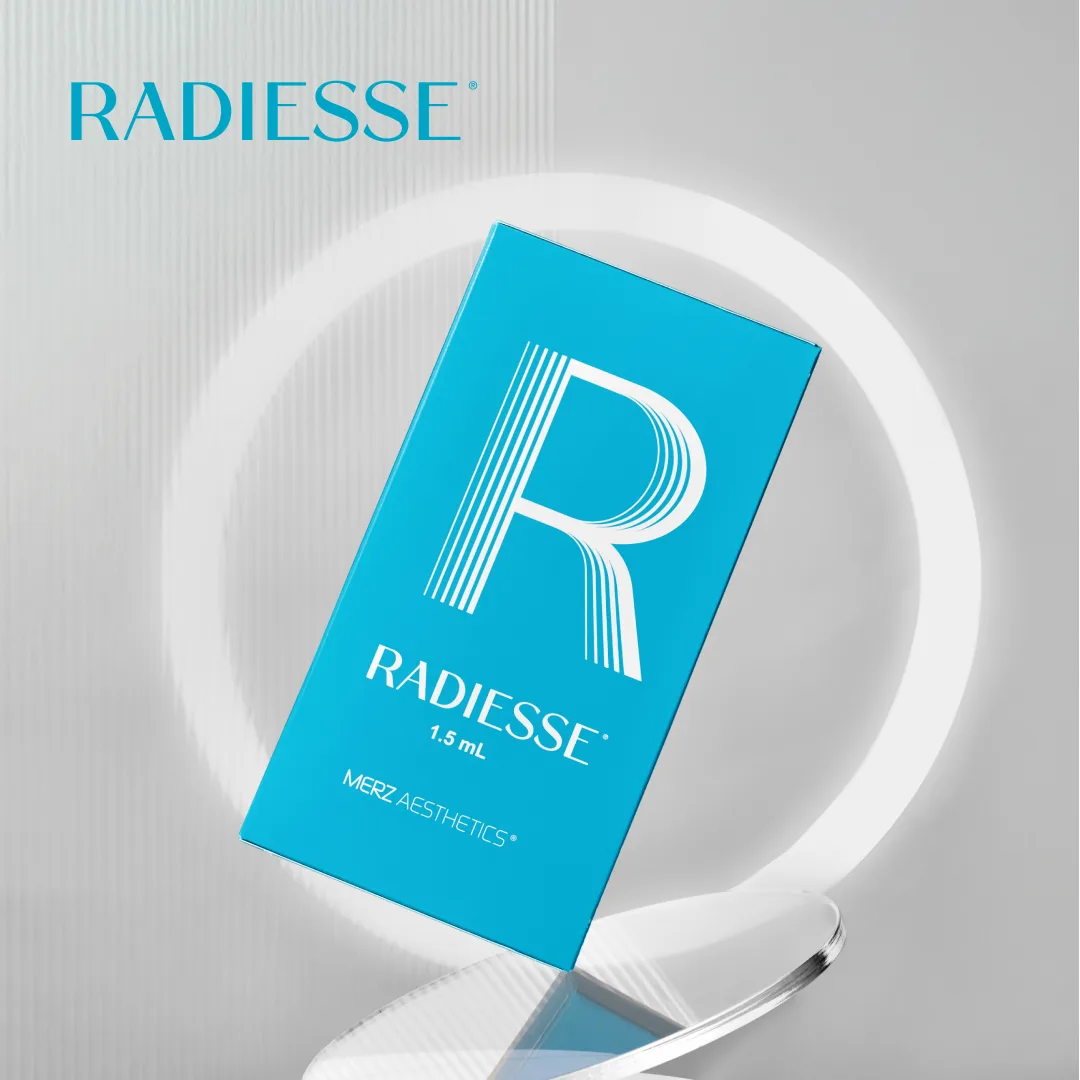
Radiesse is a calcium hydroxylapatite (CaHA) injectable, not a hyaluronic acid filler. The difference that matters most appears in an emergency: a 2021 study in Aesthetic Surgery Journal, run in human cadaver facial arteries and in vitro, reported that HA-based fillers can be dissolved inside an artery with hyaluronidase, while CaHA did not dissolve even when hyaluronidase 300 IU was combined with sodium thiosulfate 300 mg/cc, and concluded that a suitable antidote is still lacking.
Radiesse is an injectable containing calcium hydroxylapatite (CaHA). In the United States it was approved on 2006-12-22 under PMA P050052 for subdermal implantation to correct moderate to severe facial wrinkles and folds, such as nasolabial folds. A 2025 PRISMA systematic review in Aesthetic Plastic Surgery screened 1,237 records down to 29 studies and groups CaHA with poly-L-lactic acid (PLLA) and polycaprolactone (PCL) as biostimulators — a family it defines by a role in collagen induction and treats as distinct from hyaluronic acid fillers. The regulatory record tells you what it is approved to correct; the review tells you which material family it belongs to. Both are needed, because the assumptions people carry over from HA filler come from the second one.
Sources: FDA PMA P050052 — RADIESSE, facial wrinkles and foldsAesthetic Plast Surg 2025 — systematic review of biostimulators
Two things, and the second is the one that should change how you plan. The first is classification: the 2025 review separates biostimulators — PLLA, CaHA, PCL — from HA fillers and describes their role as collagen induction. The second is what can be done when filler ends up inside an artery. The 2021 Aesthetic Surgery Journal study, performed in human cadaver facial arteries and in vitro, reported that HA-based fillers can be dissolved inside the artery with hyaluronidase, that no such information existed for CaHA, and that its own attempt failed: sodium thiosulfate 300 mg/cc combined with hyaluronidase 300 IU did not dissolve CaHA inside the artery. Two syringes can look identical on a tray and differ completely on that single point.
Sources: Aesthetic Plast Surg 2025 — systematic review of biostimulatorsAesthetic Surgery Journal 2021 — CaHA and hyaluronidase, cadaver and in vitro study
Four records are verified on this page and they are separate from one another. On 2006-12-22, PMA P050052 covered subdermal implantation for the correction of moderate to severe facial wrinkles and folds, such as nasolabial folds; a separate PMA approved the same day, P050037, covered correction of facial lipoatrophy in people with HIV. On 2015-06-04, supplement P050052/S049 added hand augmentation to correct volume loss in the dorsum of the hands. On 2021-09-01, supplement P050052/S129 added deep injection — subdermal and/or supraperiosteal — for soft tissue augmentation to improve moderate to severe loss of jawline contour in adults over the age of 21, and the device named in that supplement is RADIESSE (+) Lidocaine. Two cautions follow. A PMA number is not a one-to-one label for a product name, since two numbers coexist from the same day and the jawline record names a lidocaine-containing device. And none of these records covers the neck. This page also makes no statement about Korean registration, because it verified none.
Sources: FDA PMA P050052 — RADIESSE, facial wrinkles and foldsFDA PMA P050037 — RADIESSE, HIV-associated facial lipoatrophyFDA — RADIESSE hand augmentation supplement P050052/S049, summary of safety and effectivenessFDA — RADIESSE (+) Lidocaine jawline supplement P050052/S129, summary of safety and effectiveness
Both had a control arm and blinded evaluators, which is worth knowing because neither is standard in aesthetic marketing material. The jawline study was a 60-week prospective, multicenter, randomized, controlled trial at 15 U.S. sites: 180 subjects randomized 2:1, 123 treated against 57 in a no-treatment delayed control arm, evaluator-blinded, with the primary endpoint at 12 weeks on a jawline assessment scale; the responder rate was 75.6% (p<0.0001) and 77.2% of subjects completed 60 weeks. The hand study was a multicenter, prospective, randomized cross-over trial at 6 sites: 114 subjects allocated 3:1 immediate to delayed, the delayed group serving as a 3-month no-treatment control before crossing over, treating investigators unblinded and evaluators blinded, 12 months in total; on the primary hand grading scale at 12 weeks, 64 of 85 subjects (75.3%) were responders.
Sources: FDA — RADIESSE (+) Lidocaine jawline supplement P050052/S129, summary of safety and effectivenessFDA — RADIESSE hand augmentation supplement P050052/S049, summary of safety and effectiveness
Because both protocols allowed re-treatment before the observation period ended. In the jawline trial re-treatment was permitted at week 48; in the hand trial, from 6 months. Once a subject can be injected again inside the observation window, the later timepoints stop describing how long one session lasted and start describing how the cohort looked while the study was still running. The figures anchored to a defined endpoint are the primary ones — 75.6% at 12 weeks for the jawline and 75.3% at 12 weeks for the hands. This page therefore publishes no duration figure for Radiesse. A duration quoted to you in a consultation is a clinical estimate, not something these records establish.
Sources: FDA — RADIESSE (+) Lidocaine jawline supplement P050052/S129, summary of safety and effectivenessFDA — RADIESSE hand augmentation supplement P050052/S049, summary of safety and effectiveness
No, and this is the most important line on the page. The 2021 Aesthetic Surgery Journal study worked in human cadaver facial arteries and in vitro. It reported that HA-based fillers can be dissolved inside an artery with hyaluronidase, that no equivalent information existed for CaHA, and that its own experiment failed — sodium thiosulfate 300 mg/cc combined with hyaluronidase 300 IU did not dissolve CaHA inside the artery. The authors’ conclusion was that a suitable antidote is still lacking. Nothing on this page should be read as saying a CaHA occlusion can be reversed the way an HA occlusion can.
Sources: Aesthetic Surgery Journal 2021 — CaHA and hyaluronidase, cadaver and in vitro study
Less than people assume, and the two studies here have to be kept apart. A 2026 study in Facial Plastic Surgery used a rabbit ear artery model with 6 animals, 3 given hyaluronidase and 3 not, and reported blood flow at day 7 of 58% in the hyaluronidase group against 10% without it; the authors’ conclusion is that hyaluronidase improves tissue viability. That is a different claim from dissolving the material. The source that speaks to dissolution is the 2021 cadaver study, and there the attempt failed. Read side by side: one reports that CaHA was not dissolved and that a suitable antidote is still lacking, the other reports better tissue survival in six rabbit ears. Neither makes a CaHA occlusion reversible, which is why the questions worth asking before booking are who would recognise it, how fast you could be seen, and what the clinic’s written plan is.
Sources: Aesthetic Surgery Journal 2021 — CaHA and hyaluronidase, cadaver and in vitro studyFacial Plastic Surgery 2026 — hyaluronidase and tissue viability in a rabbit ear artery model
Ask this before accepting a number. The jawline trial ran 60 weeks with its primary endpoint scored at 12 weeks (75.6% responders, p<0.0001), but re-treatment was allowed from week 48; the hand trial ran 12 months with its primary endpoint also scored at 12 weeks (75.3% responders), and re-treatment was allowed from month 6. Because both trials permitted re-injection inside the observation window, nothing measured past those re-treatment points describes how long one session lasted — it describes a cohort that may already include people who received a second injection. Neither record establishes a duration figure for a single treatment. What actually governs how long an injection holds is the movement and lymphatic turnover of the treated area, the volume and depth placed, and your own metabolism — none of which either trial isolates. Ask your injector for their own re-treatment interval by area, and whether that estimate assumes one session or an ongoing schedule.
Sources: FDA — RADIESSE (+) Lidocaine jawline supplement P050052/S129, summary of safety and effectivenessFDA — RADIESSE hand augmentation supplement P050052/S049, summary of safety and effectiveness
The 2025 systematic review screened 1,237 records and included 29 studies covering PLLA, CaHA and PCL. It reports erythema, bruising and nodules at 15–30%, with granuloma and vascular occlusion described as rare. Read that range as a class figure pooled across three different materials and many study designs — it is not an incidence measured for Radiesse alone, and this page has no product-specific rate. What it is good for is asking about events by name, and knowing that nodules are common enough in this family to deserve a plan rather than a reassurance.
Sources: Aesthetic Plast Surg 2025 — systematic review of biostimulators
Ask for the name on the box and the syringe rather than the name on the menu. Two points decide whether any U.S. record on this page is even relevant: whether the device is RADIESSE or RADIESSE (+) Lidocaine, since the jawline supplement names the latter, and which area is being treated, since wrinkles and folds, HIV-associated facial lipoatrophy, the dorsum of the hands and the jawline are four separate records. Then ask which registration applies where you are treated. This page verified U.S. records only.
Sources: FDA PMA P050052 — RADIESSE, facial wrinkles and foldsFDA PMA P050037 — RADIESSE, HIV-associated facial lipoatrophyFDA — RADIESSE hand augmentation supplement P050052/S049, summary of safety and effectivenessFDA — RADIESSE (+) Lidocaine jawline supplement P050052/S129, summary of safety and effectiveness
Six things. Which exact device, with or without lidocaine. Which area, and whether any record covers that area. Who injects, and what training they hold. What happens if blanching, escalating pain or a vision change occurs during injection — asked in the knowledge that the dissolution route available for HA filler is not available for this material. How quickly you could be seen afterwards, and who answers outside opening hours. And how a nodule appearing weeks later would be assessed. Bring a full list of previous injectables with product names and dates.
Sources: Aesthetic Surgery Journal 2021 — CaHA and hyaluronidase, cadaver and in vitro studyFacial Plastic Surgery 2026 — hyaluronidase and tissue viability in a rabbit ear artery modelAesthetic Plast Surg 2025 — systematic review of biostimulators
No. This table sorts materials rather than products, and lines up what the sources on this page state against what they do not cover.
| Material in the syringe | How the sources here classify it | What the sources say about filler inside an artery | What this page cannot confirm |
|---|---|---|---|
| CaHA (Radiesse) | Biostimulator in the 2025 systematic review, grouped with PLLA and PCL, role described as collagen induction | The 2021 cadaver and in vitro study reported that hyaluronidase 300 IU with sodium thiosulfate 300 mg/cc failed to dissolve intra-arterial CaHA and concluded a suitable antidote is still lacking; a separate rabbit ear artery model (6 animals) reported improved tissue viability with hyaluronidase, which is not dissolution | Korean registration; any duration beyond the study endpoints |
| HA filler | Treated in the same review as a category distinct from biostimulators | The 2021 study reported that HA-based fillers can be dissolved inside the artery with hyaluronidase | Product-level approvals, which differ product by product and area by area |
| PLLA / PCL | Also grouped as biostimulators in the same review | Not addressed by the sources on this page | Whether any dissolution route exists for these materials |
This table sorts materials, not products, and it is neither a ranking nor a recommendation. Emergency management is a decision for the treating doctor.
Sources: Aesthetic Surgery Journal 2021 — CaHA and hyaluronidase, cadaver and in vitro studyFacial Plastic Surgery 2026 — hyaluronidase and tissue viability in a rabbit ear artery modelAesthetic Plast Surg 2025 — systematic review of biostimulators
Care is provided by the medical team at the branch you select. These clinicians lead the three branches linked from this guide; confirm the doctor assigned to your visit with that branch.
Chief MD, Gangnam
The trust our patients have placed in this clinic was built on conviction and principle. We intend to hold to both, unchanged, through the next hundred years.

Chief MD, Myeongdong
I want to be thinking about how the patient feels right up to the last moment of the procedure.

Chief MD, Hongdae
I will give my best with the attentiveness to catch even the smallest change.
Listed branch medical team — not a medical-review byline for this article.
No. Radiesse is a calcium hydroxylapatite (CaHA) injectable, and the 2025 systematic review cited here groups CaHA with PLLA and PCL as biostimulators, a family it treats as distinct from HA fillers. The consequence is practical rather than chemical: the 2021 cadaver study reported that HA-based fillers can be dissolved inside an artery with hyaluronidase, while CaHA was not dissolved even with hyaluronidase combined with sodium thiosulfate. If a menu lists it under fillers, ask which material is in the syringe before you compare it with anything else on that list.
Both are correct in their own frame, and they answer different questions. The U.S. records quoted here are device premarket approvals: P050052 for facial wrinkles and folds, P050037 for HIV-associated facial lipoatrophy, with later supplements for the dorsum of the hands and for jawline contour. The 2025 review is a literature classification that places CaHA among biostimulators with a role in collagen induction. Use the first to check what an area-specific approval actually says, and the second to understand why HA-filler assumptions do not carry over.
They describe placement and a class-level role, not a timeline. The regulatory wording is physical: subdermal implantation for wrinkles and folds, and deep subdermal and/or supraperiosteal injection for jawline contour. The 2025 review adds a role in collagen induction shared across PLLA, CaHA and PCL. How quickly one person sees change, and how long it holds, is not established by these records — and the trials that might have shown it allowed re-treatment before they ended. Ask the clinic what it expects and what that expectation is based on.
Not by the same route. The dissolving step people describe with HA filler is hyaluronidase acting on hyaluronic acid, and CaHA is a different material: the 2021 study in Aesthetic Surgery Journal reported that its attempt to dissolve CaHA inside an artery failed even with hyaluronidase 300 IU plus sodium thiosulfate 300 mg/cc, and concluded a suitable antidote is still lacking. Plan on the basis that this is not a decision you can hand back on request, and settle expectations before the injection rather than after. Anything done about an unwanted result is a clinical judgement by the treating doctor, not a product feature.
The sources here place them in one family and do not rank them against each other. The 2025 review defines PLLA, CaHA and PCL together as biostimulators with a role in collagen induction, and reports adverse events for the group as a whole — erythema, bruising and nodules at 15–30%, with granuloma and vascular occlusion rare. What differs in a way this page can show is the paperwork: the U.S. records verified here are area-specific and belong to CaHA. Products marketed as PDLLA are not covered by any source on this page, so no comparison is offered for them.
No — each record names its own area and its own conditions. Facial wrinkles and folds such as nasolabial folds, facial lipoatrophy in people with HIV, volume loss in the dorsum of the hands, and moderate to severe loss of jawline contour in adults over the age of 21 are four separate U.S. records, the last naming RADIESSE (+) Lidocaine. None of them covers the neck. Match the area you want treated to a record instead of assuming the brand carries across areas.
Discomfort during injection is expected, and the device named in the jawline supplement is RADIESSE (+) Lidocaine, so ask which version is being used and how the clinic handles anaesthesia. For the days after, the class-level review lists erythema, bruising and nodules at 15–30% across PLLA, CaHA and PCL studies — a family figure rather than a Radiesse rate. Plan the days around your appointment on the assumption that visible bruising is possible rather than unlikely, especially if you are travelling on a fixed schedule.
Skin blanching, pain that is severe or keeps increasing, a mottled or dusky colour change, and any change in vision need immediate medical attention rather than watchful waiting. The reason to move faster here than with an HA filler is the missing route: the 2021 study concluded that a suitable antidote for CaHA is still lacking, and the rabbit ear artery study that reported better tissue viability with hyaluronidase involved six animals and did not report dissolution. Before you book, ask how to reach the clinic outside opening hours and how far you will be staying from it.
The sources here give study protocols, not a schedule. In the jawline trial re-treatment was permitted at week 48; in the hand trial, from 6 months. Those are the windows investigators allowed inside a study, which is also the reason the later readings in those trials cannot be read as duration. Your own interval is a clinical decision, so ask what it would be based on and what the options are if you want a change sooner.
This page does not reproduce the product labeling, so treat this as disclosure rather than a contraindication list. Tell the injector about every previous injectable with product names and dates, about any active infection or inflammation in the area, and about any history of lumps or granuloma after an aesthetic injection, since the class review lists nodules among common events and granuloma among rare ones. Note also that the jawline record is written for adults over the age of 21. The labeling for the exact device being used is the document that decides candidacy, and the clinic can show it to you.
Report it rather than waiting it out. The 2025 class review lists nodules alongside erythema and bruising at 15–30% across biostimulator studies and describes granuloma as rare, and none of the sources here describe a dissolution route for CaHA — so a late nodule is a clinical assessment, not something reversed with an injection on request. Keep a record of which product went where and when, because that is where the assessment starts. Contact the treating clinic first, and tell any doctor you see afterwards that the material was calcium hydroxylapatite rather than hyaluronic acid.
No. Approval is granted country by country, and this page carries U.S. device records only: 2006-12-22 for facial wrinkles and folds and, under a separate PMA the same day, for HIV-associated facial lipoatrophy; 2015-06-04 for the dorsum of the hands; 2021-09-01 for jawline contour. This page makes no statement about Korean registration for any Radiesse product, because it verified none. Ask the clinic to show the packaging and the registration that applies where you are treated.
This page publishes no prices, so line up what each quote contains before comparing numbers. Match the exact device name including whether it contains lidocaine, how much product the quote covers, the area treated, whether review visits are included, and what the clinic does — and charges — if a complication needs managing. Quotes built on different devices and different volumes are not comparable figures, whatever the headline says.
Start from the area and the emergency plan rather than the brand. Decide which area you want changed, check whether any record on this page names that area, ask which registration applies locally, and ask what the clinic would do if a vessel were involved — knowing that the hyaluronidase route used for HA filler is not available for CaHA. If the answers come back as confidence in a brand rather than a procedure, keep asking.
We started in Gangnam in 2006 and the network now runs 17 branches across Korea. The line we work to is skin transformation woven into everyday life — care you can keep up with, rather than one dramatic change.
Free Consultation
There is no inquiry form on this page. Once you have picked a branch above, open that branch’s site or the official reservation center and choose a time yourself.