
Chief MD, Gangnam
Duk-ha Kim
The trust our patients have placed in this clinic was built on conviction and principle. We intend to hold to both, unchanged, through the next hundred years.
 Seoul
Seoul

Hyaluronic-acid skin-smoothness injectable guide
SKINVIVE by JUVEDERM is a hyaluronic-acid injectable placed into the dermis, and its manufacturer positions it for skin smoothness rather than for adding volume. Its approved wording is not the same in every country: the U.S. FDA indication and the Korean product wording describe different things, and because treatment happens in Korea, the Korean wording is the one that applies to you.
It is a hyaluronic-acid (HA) injectable placed into the dermis, sold within the JUVEDERM collection. The U.S. Food and Drug Administration lists it under premarket approval P110033 supplement S059, approved on 11 May 2023, with Allergan as the applicant. The database record files it under product code LMH with the generic name Implant, dermal, for aesthetic use, and the supplement is a Panel Track supplement — meaning it was added to an existing premarket approval after review rather than issued as a brand-new standalone approval. Those record details matter more than the marketing name, because the approval attaches to that named product and to the wording written on that record, not to a treatment style or a category.

Sources: FDA — SKINVIVE by JUVEDERM (P110033/S059)FDA PMA database record — P110033/S059
It is not used to add volume. Allergan Aesthetics separates its own portfolio on exactly this line: other JUVEDERM products are presented for volume augmentation and for correcting lines and folds, while SKINVIVE is presented as targeting skin quality — smoothness and hydration — without adding volume to the face. That is a different job, and it changes what a result would even look like. A volume filler is judged by whether a contour changed; this product is described by its maker in terms of how the skin surface behaves. If a consultation frames it as a cheaper way to get the effect of a volumising filler, that framing contradicts the manufacturer’s own positioning of the product.
The FDA wording is narrow and worth reading literally: the device is indicated for intradermal injection to improve facial skin smoothness of the cheeks in people 21 years of age and older. Three limits are built into that one sentence. The route is intradermal, not deeper. The area is the cheeks, not the face in general. The population starts at 21 years of age. Nothing in that sentence covers the under-eye area, the neck, the hands or the forehead, and nothing in it mentions hydration as an approved outcome. When a page or a clinic quotes FDA approval as shorthand for approved for skin quality everywhere, it is quoting the fact of approval while dropping the sentence that defines it.
Sources: FDA — SKINVIVE by JUVEDERM (P110033/S059)FDA PMA database record — P110033/S059
It describes a different thing, and this is the part that applies to you. On the Korean official site the product is presented under the device category for tissue-restoration biomaterials, with wording covering temporary improvement of moderate to severe fine lines on the cheeks of the face in adults, administered by intra-dermal injection. Line the two up and four differences appear. The U.S. record talks about improving skin smoothness; the Korean wording talks about fine lines. The Korean wording carries a severity qualifier, moderate to severe, that the U.S. sentence does not have. The Korean wording says temporary out loud. And the U.S. record sets an age floor of 21 while the Korean wording says adults. The shared elements are the intradermal route and the cheek area. Because you are treated in Korea, quoting the U.S. sentence as though it were the domestic one is not a translation difference — it describes a scope that was not approved here. One more thing about that page: it publishes no approval or item-permit number, so this guide leaves that field empty rather than filling it with a plausible-looking figure. If a clinic, a blog or an agency quotes a specific Korean permit number for this product, ask where it comes from and ask to see it on the packaging or on the manufacturer’s own material.
Sources: AbbVie Korea — SKINVIVE official siteFDA — SKINVIVE by JUVEDERM (P110033/S059)
A randomised, multicentre, evaluator-blinded study with a no-treatment control, registered as NCT03728309. It enrolled 209 participants, 136 in the treatment group and 73 in the control group, and ran from 9 November 2018 to 17 July 2020. The primary endpoint was measured at month 1: the proportion of participants improving by at least 1 point on the Allergan Cheek Smoothness Scale in both cheeks. Two design details carry weight. Evaluator-blinded means the assessor did not know the assignment, not that participants were unaware — with a no-treatment control there is nothing for a participant to be blinded to. And a no-treatment control is not a placebo injection, so the comparison is against people who received nothing at all, which cannot separate the material from the act of injecting.
They come from a smaller group than the study enrolled, and they answer a narrow question. The manufacturer reported that 58% (73 of 125) showed at least a 1-point improvement at month 1 and 56% (69 of 124) at month 6. The denominator there is about 125, while the registered study enrolled 209 — so these percentages describe an effectiveness analysis set, not everyone who took part, and the two numbers should never be quoted without that gap attached. Add the rest of the frame: the primary endpoint was month 1, the comparator group received no treatment rather than a placebo injection, and the improvement threshold is a single point on a rating scale, which is the smallest step that scale can register. The manufacturer’s duration phrasing is up to 6 months with optimal treatment — a ceiling with a condition attached, not a period you can plan around.
Sources: AbbVie — SKINVIVE by JUVEDERM receives U.S. FDA approvalClinicalTrials.gov NCT03728309 — pivotal studyAllergan Aesthetics — SKINVIVE brand page
The pivotal trial measured its primary endpoint at month 1 and reported the same 1-point smoothness threshold again at month 6, when 56% of an analysis set of about 125 people still showed that level of improvement — a smaller group than the 209 enrolled, and a single point on a rating scale rather than a stable plateau. Because the comparator arm received no treatment rather than a placebo injection, the trial cannot separate how much of that curve is the HA material breaking down over time from how much is the visible effect of an injection simply fading. The manufacturer’s own phrasing, up to 6 months with optimal treatment, is a ceiling attached to a treatment condition, not a fixed number of months every patient should expect. What is likely to move that number for an individual includes how many sessions the clinic plans (optimal treatment implies more than one), the area treated, and each patient’s own rate of clearing injected HA. Ask the clinic how many sessions its optimal treatment means, whether it is quoting the roughly 125-person analysis set or the full 209 enrolled, and what it checks at month 6 to decide whether to repeat.
Sources: ClinicalTrials.gov NCT03728309 — pivotal studyAbbVie — SKINVIVE by JUVEDERM receives U.S. FDA approvalAllergan Aesthetics — SKINVIVE brand page
This is general HA data, not a SKINVIVE complication rate — read it that way and it is still useful. A retrospective series from a university centre in Hamburg reviewed 31 patients seen between January 2019 and January 2025 after hyaluronic-acid injections. Delayed nodules were recorded in 32.1%, the Tyndall effect — a bluish tint where superficial product shows through the skin — in 22.6%, infection or erysipelas in 16.1% to 22.6%, vascular occlusion or necrosis in 12.9%, and filler migration in 9.7%. Every one of those figures describes patients who were referred to a specialist centre because something went wrong, so it is a picture of what problems look like when they occur, not of how often they occur. Delayed nodules being the largest category is the practically relevant part: a problem can begin weeks after an uneventful appointment.
Sources: Nguyen L et al., J Cosmet Dermatol 2026;25(1):e70582 — HA injection complications
Because in that same series, more than half of the cases involved uncertified products or products whose origin could not be determined. That single finding reorders the checklist. Depth, technique and injector experience all matter, but they are hard for a patient to verify in the room, whereas what is in the syringe is checkable in about thirty seconds. Ask for the product by full name, ask to see the outer box and the lot number before it is opened, and confirm that it is a product legitimately distributed in Korea. An unnamed product described only as an imported HA booster, a premium HA or by a clinic’s in-house programme name is the exact situation that series is describing.
Sources: Nguyen L et al., J Cosmet Dermatol 2026;25(1):e70582 — HA injection complicationsAbbVie Korea — SKINVIVE official site
They are not classifications, and nothing is approved under them. Those phrases are marketplace shorthand covering a wide range of different injectables with different materials, different approved wordings and different evidence. Regulatory records do not work that way: the U.S. approval and the Korean product wording both attach to one named product. So a booking described as a water-glow session or a skin-booster package tells you almost nothing about what will be injected, and two clinics using the same phrase may be describing entirely different products. Treat the phrase as the start of a question — which named product — rather than as an answer.
Sources: AbbVie Korea — SKINVIVE official siteFDA — SKINVIVE by JUVEDERM (P110033/S059)
Six things, and all of them are answerable in a consultation. Ask which named product will be used and ask to see the box and lot. Ask which approved wording the clinic is working from, and expect the Korean one, since that is the wording that governs treatment here. Ask which area is planned and check it against the cheeks, which is the area both records name. Ask how many sessions the plan assumes and over what interval. Ask what the clinic tells patients about duration, and compare it with the manufacturer phrasing of up to 6 months with optimal treatment. And ask how you should report a lump or a colour change that appears weeks later, especially if you will have flown home by then — agree on that route before the appointment, not after.
Sources: AbbVie Korea — SKINVIVE official siteAllergan Aesthetics — SKINVIVE brand pageNguyen L et al., J Cosmet Dermatol 2026;25(1):e70582 — HA injection complications
They are three different kinds of thing: a named product, a product class, and a spoken phrase with no regulatory meaning. Compare what each one refers to before comparing anything else.
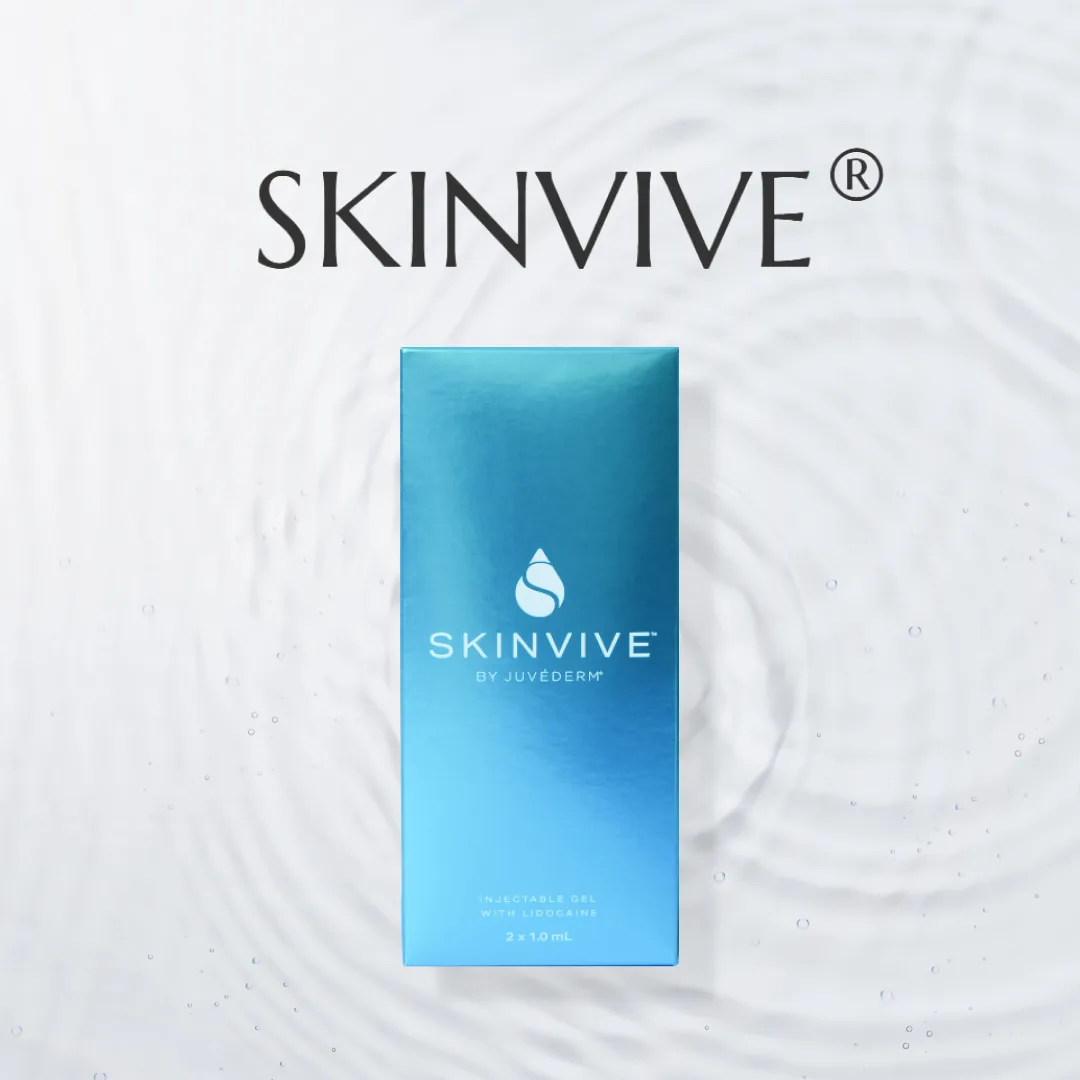
| What you might be offered | What it actually refers to | Approved wording attached to it | Confirm before booking |
|---|---|---|---|
| SKINVIVE by JUVEDERM | A named HA product injected into the dermis; the maker positions it for skin smoothness, not volume | U.S.: intradermal injection to improve facial skin smoothness of the cheeks, age 21+. Korea: temporary improvement of moderate to severe fine lines on the cheeks in adults | Which of the two wordings the clinic is working from, plus the box and lot number |
| HA volume filler (other JUVEDERM products) | HA gel placed deeper to add volume or correct lines and folds — a different job from skin smoothness | Each product carries its own approved wording and its own approved areas | The exact product name and the specific area it is approved for |
| Water glow / skin booster as a spoken category | Marketplace shorthand with no standard classification; different clinics mean different injectables by it | None — approvals attach to named products, never to a category phrase | Which named product is actually planned, before price or session count |
This table maps what the words refer to. It is not a ranking, not a recommendation, and it does not describe how any individual will respond to treatment.
Sources: Allergan Aesthetics — SKINVIVE brand pageAbbVie Korea — SKINVIVE official siteFDA — SKINVIVE by JUVEDERM (P110033/S059)
Care is provided by the medical team at the branch you select. These clinicians lead the three branches linked from this guide; confirm the doctor assigned to your visit with that branch.
Chief MD, Gangnam
The trust our patients have placed in this clinic was built on conviction and principle. We intend to hold to both, unchanged, through the next hundred years.

Chief MD, Myeongdong
I want to be thinking about how the patient feels right up to the last moment of the procedure.

Chief MD, Hongdae
I will give my best with the attentiveness to catch even the smallest change.
Listed branch medical team — not a medical-review byline for this article.
It is a hyaluronic-acid injectable, but it is not used the way a volume filler is used. Allergan Aesthetics draws the line inside its own range: other JUVEDERM products are presented for volume augmentation and for correcting lines and folds, while SKINVIVE is presented as addressing skin smoothness and hydration without adding volume. The route differs too — the U.S. indication specifies intradermal injection, which is shallower than where volumising products are placed.
It marks the product as part of the JUVEDERM collection from Allergan Aesthetics rather than a separate brand. The regulatory trail says the same thing: the U.S. clearance was issued as supplement S059 to premarket approval P110033, with Allergan as the applicant, so it was added to an existing approval as a Panel Track supplement rather than approved as a standalone new device. Being part of that family does not transfer any other JUVEDERM product’s approved wording to it.
It is injected intradermally — into the dermis — and that is the only route wording the regulatory records use. The manufacturer’s announcement describes it as an intradermal microdroplet injection, but microdroplet is the company’s description of technique, not part of any approved indication. Useful distinction at a consultation: if a clinic explains the technique, that is fine; if a clinic presents microdroplet as the regulatory category the product was approved in, that is not what the records say.
The purpose and the depth differ, even though both are hyaluronic acid. A volume filler is placed deeper and is judged on whether a contour or a fold changed; the maker positions SKINVIVE for the quality of the skin surface, explicitly without adding volume, and the U.S. indication places it intradermally. They also carry separate approved wordings — one product’s approval says nothing about another’s. Bring the change you want and the area to the consultation rather than a product name, and let the wording decide which category is even in scope.
No, because a water-glow injection is not a defined thing. It is a spoken shorthand with no standard classification, used for many different injectables that differ in material, approved wording and evidence. SKINVIVE is one named product with a specific U.S. indication and a specific Korean product wording. The practical consequence: a package sold under a category phrase tells you nothing about what is in the syringe, so the first question is always which named product, and the answer should be visible on the box.
Because each regulator approves its own wording, and here the two sentences genuinely describe different things. The U.S. indication reads: intradermal injection to improve facial skin smoothness of the cheeks in people 21 years of age and older. The Korean official site presents the product under the tissue-restoration biomaterial category for temporary improvement of moderate to severe fine lines on the cheeks of the face in adults, by intra-dermal injection. The Korean version names fine lines rather than smoothness, adds a moderate-to-severe severity qualifier, states temporary explicitly, and says adults rather than 21 and older. Since your treatment takes place in Korea, the Korean wording is the one that applies.
This page does not publish a symptom or recovery list for this product, because none of the sources cited here provides one, and inventing a list would be worse than leaving it out. What the records do say is that the injection goes into the dermis, which is shallow, and is delivered across multiple points. Ask the clinic for the product’s own instructions for use and the reactions listed in it, and ask specifically how long any visible injection marks typically remain if you have a flight or an event booked.
Contact the treating clinic rather than waiting to see whether it settles. Delayed nodules were the single largest category in a retrospective series of 31 patients referred after hyaluronic-acid injections, recorded in 32.1% of them, and filler migration appeared in 9.7%. That series covers HA injections in general, not this product specifically, and it counts referred problem cases rather than measuring how often problems occur — but it does establish that a complication can begin well after an uneventful appointment, which is why a contact route agreed before you travel home is worth more than any reassurance given on the day.
The sources cited here do not set a session number, so this page does not state one. On duration, the manufacturer’s brand page says up to 6 months with optimal treatment — an upper bound with a condition attached, not a period you can count on. The study evidence sits mostly at the front end: the primary endpoint was assessed at month 1, and the 6-month figure of 56% (69 of 124) comes from the same analysis set of roughly 125 people, not from the 209 enrolled.
The sources cited here do not provide a contraindication list, so this page does not publish one — ask the clinic for the product’s instructions for use. What the records do fix is the population wording: the U.S. indication is written for people 21 years of age and older, and the Korean wording is written for adults. Bring your allergy history, any autoimmune condition, current medication, and every previous injectable in the same area — including any product whose name you were never told, since unidentified prior product is exactly what complicates later assessment.
The most serious reported in that Hamburg series were vascular occlusion or necrosis, recorded in 12.9% of the 31 referred patients, alongside infection or erysipelas at 16.1% to 22.6% and the Tyndall effect at 22.6%. Again, this is HA injection in general and a referred caseload, not an incidence rate for any one product. The practical takeaway is about timing: severe or disproportionate pain, blanching or a colour change in the skin during or shortly after an injection is a reason to contact the treating clinic immediately rather than at the next scheduled visit.
It is presented on the Korean official site with Korean product wording and a Korean device category, but this page does not state an approval number because that site does not publish one. That absence is worth using rather than ignoring: if a clinic or an agency quotes a specific Korean permit number for this product, ask to see it on the packaging or on the manufacturer’s own material. A number that cannot be traced to a primary source proves nothing about what will be injected.
This page does not publish prices, so compare what one session contains rather than the headline figure. Line up the named product, how much product one session includes, how many sessions the plan assumes, the interval between them, whether a follow-up visit is included, and whether the quote covers assessment of a delayed problem after you have gone home. Two quotes are only comparable once those items match — and a quote that will not name the product cannot be compared with anything.
The approved wordings answer that more precisely than any consultation summary: the cheeks, in adults. The U.S. record names facial skin smoothness of the cheeks in people 21 and older; the Korean wording names moderate to severe fine lines on the cheeks of the face in adults. Neither covers the under-eye area, the neck, the hands or the whole face, so a plan extending to those areas is outside the wording on both records. That does not make such a plan impossible, but it does mean you should be told plainly that it goes beyond what was approved.
We started in Gangnam in 2006 and the network now runs 17 branches across Korea. The line we work to is skin transformation woven into everyday life — care you can keep up with, rather than one dramatic change.
Free Consultation
There is no inquiry form on this page. Once you have picked a branch above, open that branch’s site or the official reservation center and choose a time yourself.