
Chief MD, Gangnam
Duk-ha Kim
The trust our patients have placed in this clinic was built on conviction and principle. We intend to hold to both, unchanged, through the next hundred years.
 Seoul
Seoul
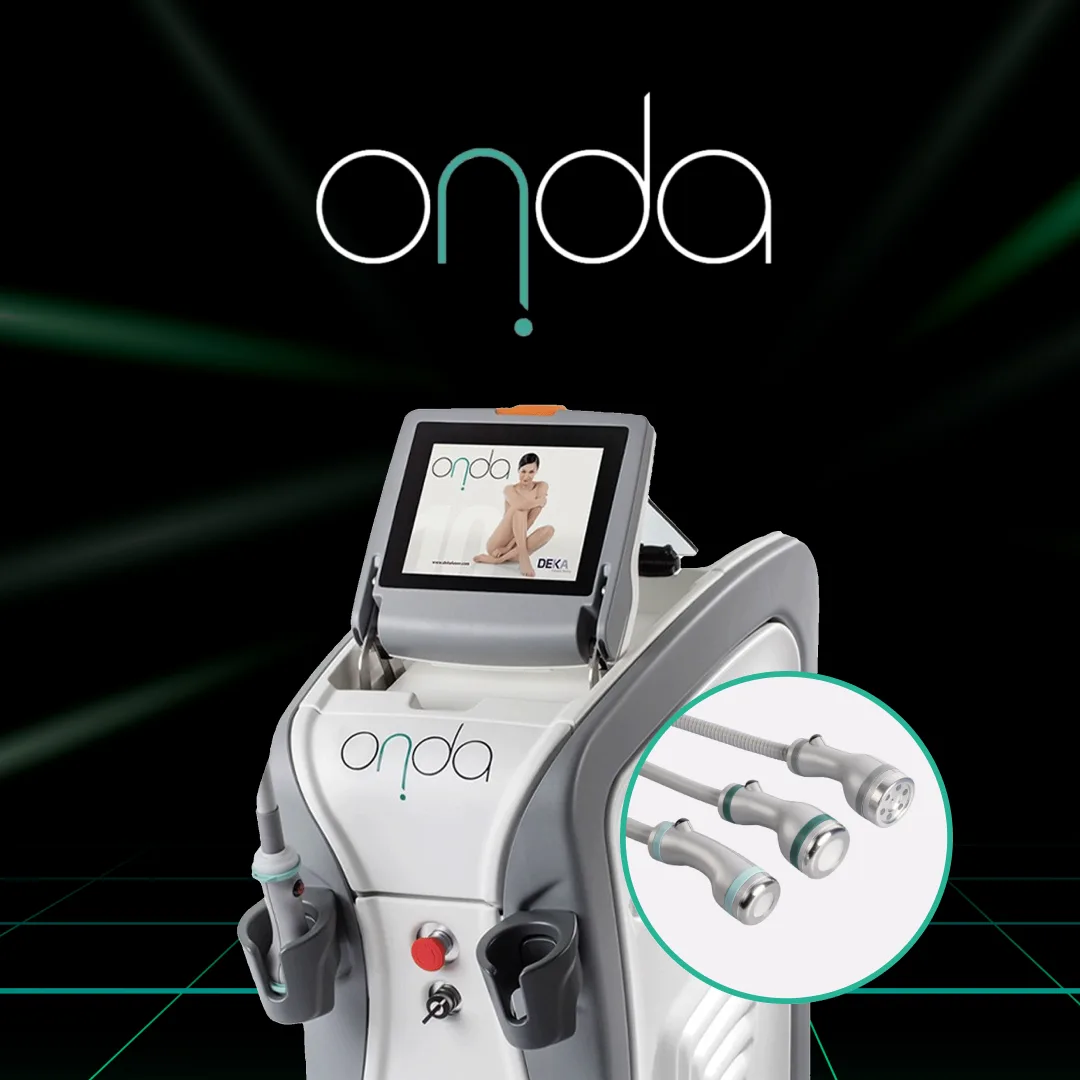
Microwave body treatment by area
The areas DEKA lists for ONDA are body areas: abdomen, knees, hips, buttocks and underarms, with the double chin as the only facial-region use. Treatment uses 2.45 GHz Coolwaves® microwaves through a Deep handpiece for localized fat or a Shallow handpiece for cellulite, skin laxity and the double chin, in courses of three to four sessions four weeks apart in the published work.
It is the other way round. Every area DEKA lists for ONDA is a body area — abdomen, knees, hips, buttocks and underarms — and the only facial-region use in the manufacturer’s own description is the double chin, handled by the Shallow handpiece. A body booking is therefore not an extension of a face device: it is the indication set the manufacturer publishes, and both of the clinical studies cited on this page took their measurements on body areas rather than on the face.
Sources: DEKA official — ONDADermatologie (Heidelberg) 2023 — abdominal subcutaneous fat
It describes where the energy lands, not how much tissue changes. DEKA’s position is that radiofrequency energy disperses mainly through the superficial skin layers while Coolwaves® are taken up preferentially by fat tissue, which the company presents as allowing a deep and selective action. On the body this matters because the subcutaneous layer over an abdomen or the hips is not the layer you work with on a face, so the choice of handpiece is effectively a choice of working depth — the published expert recommendations put Shallow focusing at about 0.7 cm and Deep at about 1.2 cm. What the absorption statement cannot do is convert into centimetres or grams; no source cited here makes that step.
Sources: Coolwaves® official (DEKA)International Advisory Board recommendations, Bioengineering 2024;11(12):1249
They answer to different goals rather than to different strengths of one goal. DEKA assigns Deep to localized fat and Shallow to cellulite, skin laxity and the double chin; the Coolwaves® site lists Pocket, Deep and Shallow with contact cooling at 5 °C, and ONDA Plus adds a PLUS handpiece that performs an air-flow draining massage. The expert recommendations give each goal its own energy band as well as its own focusing depth, so a plan that names only the device and not the handpiece has not yet said what it is treating.
Sources: DEKA official — ONDACoolwaves® official (DEKA)DEKA official — ONDA PlusInternational Advisory Board recommendations, Bioengineering 2024;11(12):1249
At the abdomen, knees, hips, buttocks and underarms, plus the double chin under the Shallow handpiece. Areas beyond that list are not described in the material cited here, so if one is proposed it is fair to ask what the plan is based on. What is available also varies by market: DEKA notes on the ONDA Plus page that some configurations and uses are not available in the United States. And a body plan is normally written as a set of 15 × 15 cm zones rather than as a single area name, so ask how many zones a word like “abdomen” works out to in your case.
Sources: DEKA official — ONDADEKA official — ONDA PlusInternational Advisory Board recommendations, Bioengineering 2024;11(12):1249
Per zone, not per body. In the published expert recommendations the kilojoule figure is the total energy delivered to one 15 × 15 cm zone in a single session, and it is set by goal: roughly 120,000–150,000 J at 120–160 W for localized fat, 140,000–170,000 J at 130–180 W for cellulite, 110,000–150,000 J for skin laxity, and 50,000–70,000 J at 60–90 W for the double chin. Booking menus commonly sell packages labelled 20 kJ, 40 kJ or 60 kJ — figures well below those per-zone bands. That difference does not by itself mean a package is too small, because a package may assume a different area, a different number of zones and a different number of sessions than the recommendations do. What it does mean is that the two numbers are not the same unit, so the question to ask is how many zones the package covers and how many kilojoules reach each one.
Sources: International Advisory Board recommendations, Bioengineering 2024;11(12):1249
The cited protocols are courses spaced four weeks apart, which puts a body plan on a scale of months rather than one visit. The expert recommendations describe four sessions at four-week intervals; the abdominal study ran three sessions at four-week intervals and measured three months after the last one; the one-year follow-up study used four sessions. When the measurement was taken is as much a condition of those results as how many sessions were given, so a single visit does not reproduce the published course. If the sessions would straddle a trip, settle where the remaining ones happen before starting.
Sources: International Advisory Board recommendations, Bioengineering 2024;11(12):1249Dermatologie (Heidelberg) 2023 — abdominal subcutaneous fatSkin Research and Technology 2023 — 1-year follow-up
Not as far as a randomized controlled trial. The recommendations document is a consensus of 27 experts with no patient sample of its own, and its authors state that long-term safety and efficacy data are lacking and that randomized controlled trials are needed. The abdominal study enrolled 19 people in a prospective observational design with no control group, no randomization and no blinding, followed for three months; it reports a mean abdominal circumference reduction of 3.80 ± 1.21 cm three months after the final session, which is what was observed in those 19 people rather than an established effect of the device. The one-year follow-up enrolled 34 people, again without a control group or randomization and with independent blinding only of the assessors, and three of its authors are employed by the manufacturer El.En. Group; its outcome GAIS is a subjective global improvement scale, which registered 3.65 ± 0.49 for cellulite at one month against 2.7 ± 0.66 at one year, and 3.52 ± 0.51 for fat against 2.82 ± 0.88. Without a control group, diet, activity, measurement technique and the passage of time cannot be separated from the treatment.
Sources: International Advisory Board recommendations, Bioengineering 2024;11(12):1249Dermatologie (Heidelberg) 2023 — abdominal subcutaneous fatSkin Research and Technology 2023 — 1-year follow-up
The quantities being measured are different. Nothing in the sources cited here reports body weight, body-mass index or a volume of fat removed; what they report is abdominal circumference in 19 people and a subjective improvement scale in 34. Circumference is a measurement around one area, not a measure of body weight, and none of the manufacturer material presents ONDA as an obesity treatment, a weight-loss programme or a replacement for a surgical procedure. No source cited here compares ONDA with liposuction or with injection-based approaches either, so this page cannot rank them or present one as a lighter version of the other. If your goal is weight change rather than the shape of one area, say so at the consultation, because that is a different clinical conversation.
Sources: DEKA official — ONDADermatologie (Heidelberg) 2023 — abdominal subcutaneous fatSkin Research and Technology 2023 — 1-year follow-up
Less than marketing language often implies. A direct search of the openFDA 510(k) database returned no entry for ONDA or Coolwaves, so no United States clearance is claimed on this page. The verifiable statements are narrower: DEKA’s own product material lists Onda PRO in its United States and Canada catalogue, and the ONDA Plus page notes that some configurations and uses are not available in the United States. Registration is decided country by country. Ask the clinic which model is in use and under which national registration it is operated there.
The only source cited here that tracks change over time is the one-year follow-up study (n=34, no control group, no randomization, only the assessors independently blinded, three authors employed by the manufacturer El.En. Group). Its subjective GAIS score moved from 3.65 ± 0.49 at one month to 2.7 ± 0.66 at one year for cellulite, and from 3.52 ± 0.51 to 2.82 ± 0.88 for fat — a decline over the year, measured on a scale that reflects the assessor’s impression rather than an objective count. The abdominal study (n=19) measured only once, three months after the final session, so it says nothing about a point beyond that. Neither study isolates what a return to normal activity, weight change or the passage of time itself contributed. Ask the clinic what interval it recommends for a touch-up course based on its own experience with the number of zones and sessions planned for you, since the published follow-up stops at one year and was not designed to isolate the device’s own contribution.
Sources: Skin Research and Technology 2023 — 1-year follow-upDermatologie (Heidelberg) 2023 — abdominal subcutaneous fat
Settle the map before the amount. Ask which model is in the room (ONDA or ONDA Plus), which handpiece each goal uses, exactly which areas are mapped and how many 15 × 15 cm zones that comes to, the kilojoules per zone, the number of sessions and the interval, who operates the device, and how remaining sessions are handled if you leave the country. Then disclose what only you know: pregnancy or breastfeeding, implanted electronic devices such as a pacemaker, metal or implants near the mapped area, recent surgery on that area, active skin disease or infection over it, healing or bleeding problems, the medicines you take, and any aesthetic procedure done recently on the same area. The sources cited here publish no device-specific eligibility list, so that judgement belongs to the treating clinician. After a session, contact the clinic promptly for blistering or a suspected burn, pain that keeps increasing, spreading redness or warmth, drainage, fever, a firm lump that does not settle, persistent numbness, or an unexpected dent in the contour; seek emergency care for difficulty breathing, fainting, or sudden swelling of the lips, mouth, tongue or throat.
Sources: DEKA official — ONDAInternational Advisory Board recommendations, Bioengineering 2024;11(12):1249
ONDA is planned by goal and by zone, not by body part alone. The bands below come from the published expert recommendations — consensus figures rather than trial results — and each is defined per 15 × 15 cm zone per session. Use the table to work out what a given plan is actually describing.
| Handpiece and focusing depth | Energy per 15 × 15 cm zone per session | Confirm at consultation | |
|---|---|---|---|
| Localized fat on a listed area | Deep, focusing at about 1.2 cm | About 120,000–150,000 J at 120–160 W | Which areas are mapped, how many zones that is, and how a package kilojoule figure divides across them |
| Cellulite | Shallow, focusing at about 0.7 cm | About 140,000–170,000 J at 130–180 W | Whether the plan targets fat, cellulite or both — the handpiece and the band both change |
| Skin laxity | Shallow, focusing at about 0.7 cm | About 110,000–150,000 J | Whether laxity is a goal in its own right or something expected to come along with a fat plan |
| Double chin | Shallow, focusing at about 0.7 cm | About 50,000–70,000 J at 60–90 W | That this is the only facial-region entry in the manufacturer’s area list |
These are recommended figures from a 27-expert consensus document that has no patient sample of its own. They are not measured results and not a price list, and they cannot be lined up against a menu’s 20 kJ, 40 kJ or 60 kJ without knowing how many zones and sessions are involved.
Sources: International Advisory Board recommendations, Bioengineering 2024;11(12):1249DEKA official — ONDA
Care is provided by the medical team at the branch you select. These clinicians lead the three branches linked from this guide; confirm the doctor assigned to your visit with that branch.
Chief MD, Gangnam
The trust our patients have placed in this clinic was built on conviction and principle. We intend to hold to both, unchanged, through the next hundred years.

Chief MD, Myeongdong
I want to be thinking about how the patient feels right up to the last moment of the procedure.

Chief MD, Hongdae
I will give my best with the attentiveness to catch even the smallest change.
Listed branch medical team — not a medical-review byline for this article.
A course of 2.45 GHz microwave sessions over mapped body zones, delivered with DEKA’s ONDA or ONDA Plus system — Coolwaves® is DEKA’s name for that microwave technology. The word body refers to the areas mapped and the handpiece used, not to a separate machine. Because energy is planned per 15 × 15 cm zone, two bookings under the same menu name can cover very different amounts of you.
They are names for the platform and its configurations, not for different technologies. DEKA lists Onda PRO in its United States and Canada catalogue material, and ONDA Plus is the configuration that adds a PLUS handpiece performing an air-flow draining massage alongside the microwave handpieces, with a note that some configurations and uses are not available in the United States. Both clinical studies cited here used Onda Plus, so ask which unit a clinic operates before treating those figures as a description of their service.
They go as far as where the energy is absorbed and stop short of a full biological account. DEKA states that the microwaves are taken up preferentially by adipose tissue for a deep and selective action, with contact cooling at 5 °C protecting the surface during delivery, and the expert recommendations assign focusing depths of about 0.7 cm and 1.2 cm to the two handpieces. What no source cited here supplies is a measured quantity of fat removed or a described clearance route — the published outcomes are an abdominal circumference measurement and a subjective improvement scale.
Same platform, different plan. On the body the manufacturer lists abdomen, knees, hips, buttocks and underarms, with Deep for localized fat; the only facial-region entry in that list is the double chin, which uses Shallow at a far lower band — roughly 50,000–70,000 J per zone against 120,000–150,000 J for localized fat in the published recommendations. So a facial quote and a body quote are not interchangeable even under one device name: zone count, handpiece and energy per zone all differ.
Work out what unit each one sells before comparing totals. ONDA plans are built from 15 × 15 cm zones and kilojoules per zone, while RF body devices are usually quoted per applicator placement, per pass or per shot, which is not the same unit at all. On the technology itself, the only difference documented in the sources here is DEKA’s absorption claim — microwaves taken up preferentially by fat tissue against RF energy the company describes as dispersing mainly through superficial skin layers — and no head-to-head trial against a named RF body device appears in that material.
No source cited on this page supports that framing, so the page does not make the claim. Neither the DEKA material nor the two published studies compares ONDA with a surgical or injection-based procedure, which means there is no comparative outcome here to rank. What is documented for ONDA is non-invasive microwave heating in courses of three to four sessions four weeks apart, with results reported as circumference in a 19-person uncontrolled study and a subjective scale in a 34-person uncontrolled study. Which approach suits your goal is a conversation with a clinician who can examine the area.
No pain score is published in the sources cited here, for any area, so no number can be given. What is documented is contact cooling at 5 °C at the skin surface during delivery, and that a larger area means more zones and a longer session rather than a different sensation within each zone. Tell the operator during the session if the heat stops feeling tolerable — that is the only control available in real time.
The sources cited here publish no aftercare schedule, so a fixed recovery rule found online is not coming from them. The clinic that treated you knows the areas, the handpiece and the energy used, and should set the timing for exercise, heat exposure, massage, compression and long flights. What the published work does fix is the four-week rhythm between sessions, which matters more for travel planning than the hours after any single session.
Not into the schedule the published work used. Every cited protocol spaces sessions four weeks apart — three sessions in the abdominal study, four in the expert recommendations and in the one-year follow-up. A week allows one session, and the reported measurements were taken after full courses; the abdominal study measured three months after the final session. Ask what a single session is expected to do on its own and whether the remaining sessions can be arranged on later visits.
Anything implanted, healing or currently inflamed under or near the mapped area. Tell the clinician about pregnancy or breastfeeding, implanted electronic devices such as a pacemaker, metal or implants close to the area, recent surgery on it, active skin disease or infection over it, healing or bleeding problems, the medicines you take, and any aesthetic procedure done recently on the same area. The sources cited here carry no device-specific eligibility list, so no web page — this one included — can clear you for treatment.
The sources cited here publish no incidence figures for adverse effects, so this page cannot tell you how often anything happens. What is knowable is the mechanism: ONDA works by heating tissue, and heat-based treatments carry risks including burns, blistering, prolonged redness, swelling, tenderness and contour irregularity, which is part of why treatment is planned zone by zone. The absence of an incision removes the surgical risks, not the thermal ones. Ask the clinic which reactions they expect on your area, how long those usually last, and how to reach them outside opening hours.
This page cannot confirm a United States clearance: a direct search of the openFDA 510(k) database returned no entry for ONDA or Coolwaves, so nothing is claimed on that. The verifiable points are narrower — DEKA lists Onda PRO in its United States and Canada catalogue, and its ONDA Plus page notes that some configurations and uses are not available in the United States. Approvals are national, brand names are not always searchable in public databases, and a clinic that cites an approval should be able to name the model and the registration it refers to.
Usually the zone count and the energy per zone, neither of which is visible in the amount. Line up the model (ONDA or ONDA Plus), the handpiece for each goal, the exact areas mapped, how many 15 × 15 cm zones that is, the kilojoules delivered per zone, the number of sessions and the interval, who operates the device, and whether follow-up is included. A package sold as 20 kJ, 40 kJ or 60 kJ is selling an amount of energy — meaning an amount of area and time — so two quotes covering different zone counts are not two prices for the same thing.
That is not how the manufacturer positions it. DEKA points the Deep handpiece at localized fat and the Shallow handpiece at cellulite, skin laxity and the double chin, listing areas one by one — abdomen, knees, hips, buttocks, underarms — and the cited studies report circumference and a subjective scale rather than body weight. Whether your particular area and expectations fit that framing is settled by examination, not by a web page, so bring the specific area and the change you want to the consultation.
We started in Gangnam in 2006 and the network now runs 17 branches across Korea. The line we work to is skin transformation woven into everyday life — care you can keep up with, rather than one dramatic change.
Free Consultation
There is no inquiry form on this page. Once you have picked a branch above, open that branch’s site or the official reservation center and choose a time yourself.