
Chief MD, Gangnam
Duk-ha Kim
The trust our patients have placed in this clinic was built on conviction and principle. We intend to hold to both, unchanged, through the next hundred years.
 Seoul
Seoul
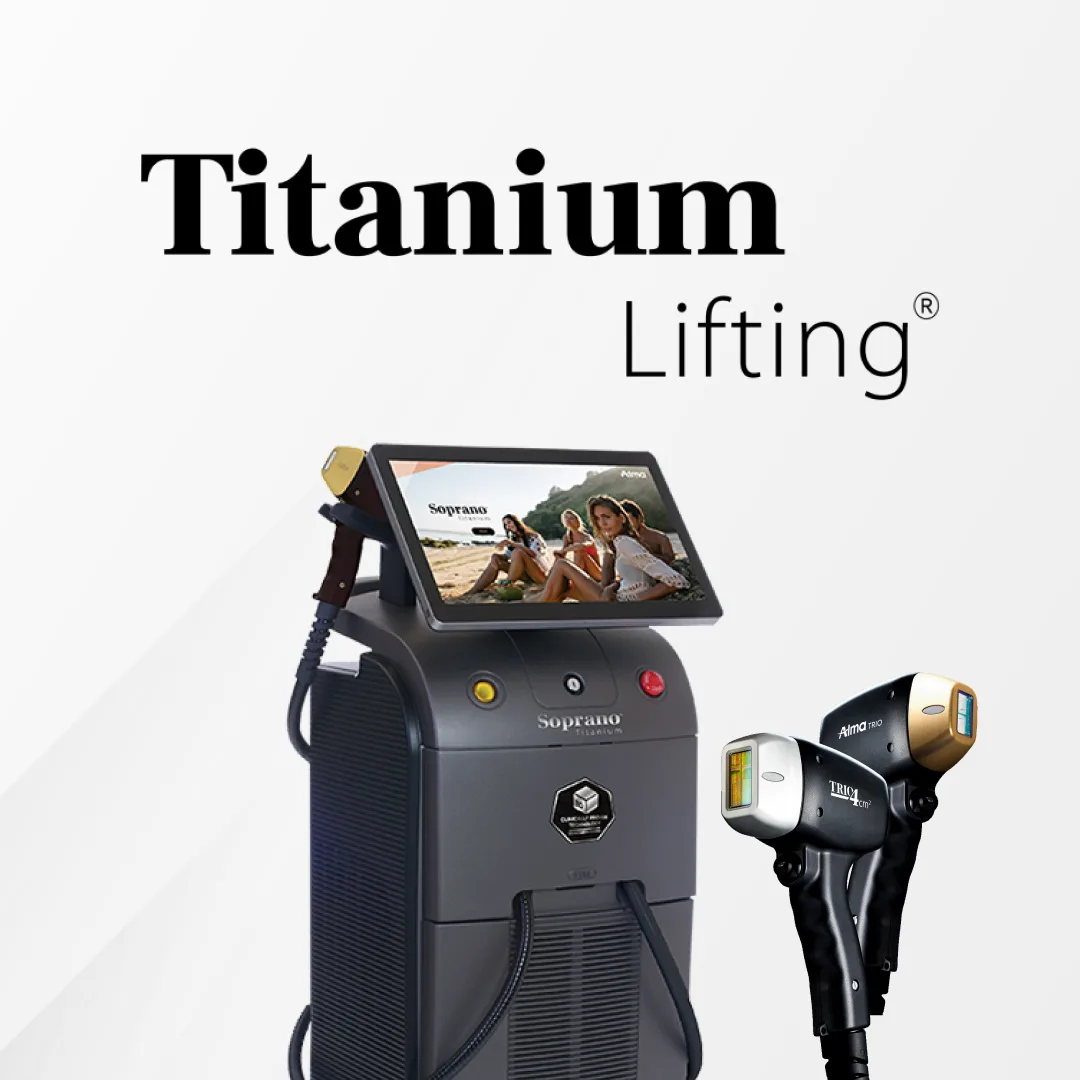
Hair removal laser platform guide
Soprano Titanium is a laser hair removal platform, not a lifting device. The manufacturer’s official product page and the US 510(k) record K222064 describe hair removal, benign vascular lesions and near-infrared heating for temporary muscle and joint pain relief — no lifting, tightening, wrinkle or collagen indication appears in either. Inside hair removal the wording splits by applicator: the SHR mode of the three-wavelength Trio applicators is cleared for temporary hair reduction, while the single-wavelength 755 nm and 810 nm applicators carry the permanent reduction in hair regrowth wording.
It is a laser hair removal platform. The manufacturer’s official product page presents it as a laser hair removal platform offering clinically proven treatments across all skin types, built around three wavelengths delivered from one handpiece family: 755 nm, 810 nm and 1064 nm. The applicator line-up published there covers TRIO 2cm², TRIO 4cm² and Trio MAX, which emit all three wavelengths, SPEED 810 and ALEX 755, which emit a single wavelength each — ALEX 755 is positioned for light and fine hair — and a Facial Tip. In the United States the system is recorded under 510(k) K222064 held by Alma Lasers Inc., a Class II device filed under product codes GEX and ILY with regulations 21 CFR 878.4810 and 21 CFR 890.550, cleared against the predicate K172193 Soprano Ice Platinum.
Sources: Alma Lasers — Soprano Titanium official product pageFDA 510(k) K222064 summary — The Alma Soprano TitaniumFDA 510(k) database record — K222064
No — and that is the single most useful thing to establish before booking. Neither the manufacturer’s product page nor the 510(k) summary carries a lifting, tightening, wrinkle or collagen claim of any kind. What the cleared indications do cover is hair, vessels and heat: temporary hair reduction in the SHR mode of the three-wavelength Trio applicators, permanent reduction in hair regrowth for the single-wavelength 810 nm and 755 nm applicators, benign vascular and vascular dependent lesions in the Trio HR mode, and a near-infrared applicator for temporary relief of minor muscle and joint pain together with a temporary increase in local blood circulation. That near-infrared entry is the only heating indication in the record, and it is written about muscle and joint pain and local circulation rather than about skin lifting. Where a menu files the device under a lifting heading, that is a categorisation made by whoever wrote the menu, not a statement carried by the regulatory record.
Sources: FDA 510(k) K222064 summary — The Alma Soprano TitaniumAlma Lasers — Soprano Titanium official product page
All three aim at the same chromophore and differ in how deep they reach and how much the epidermis absorbs on the way. The dermatology literature describes the target of laser hair removal as melanin in the hair, which absorbs light across roughly 300 to 1200 nm — every wavelength on this platform sits inside that band. Within it, 755 nm alexandrite light is strongly absorbed by melanin, which is why it is directed mainly at lighter skin tones, and the manufacturer positions its ALEX 755 applicator for light and fine hair. An 810 nm diode is described as safer in darker skin, covering types I to V. A 1064 nm Nd:YAG offers better penetration with less epidermal damage and relatively less melanin absorption across types I to VI, which is the basis for its use on deeply pigmented skin. The Trio applicators emit all three simultaneously; what that combination is cleared for is a separate question from what each wavelength does.
Sources: StatPearls — Laser hair removal (NCBI Bookshelf)Alma Lasers — Soprano Titanium official product page
Because the 510(k) writes the indications applicator by applicator, and the wording is not the same for all of them. The summary states that the Super Hair Removal (SHR) Mode is intended for temporary hair reduction — that is the mode in which the Trio applicators fire all three wavelengths together. The permanent reduction in hair regrowth wording belongs instead to the single-wavelength 810 nm and 755 nm applicators. In HR mode the Trio applicators are covered for benign vascular and vascular dependent lesions, and the near-infrared applicator sits under its own heading for temporary pain relief and increased local circulation. So the intuitive reading — three wavelengths at once, therefore a more lasting result — runs against the record: the permanence wording is attached to the single-wavelength applicators, while the simultaneous three-wavelength mode is cleared for temporary hair reduction. For the same reason a product name should not be matched one-to-one with a clearance number. The Soprano line carries more than one number, the predicate K172193 Soprano Ice Platinum among them, and the indications split by applicator inside a single number.
Sources: FDA 510(k) K222064 summary — The Alma Soprano TitaniumFDA 510(k) database record — K222064
It means a measured reduction in the number of hairs that regrow, not the absence of hair. The 510(k) summary spells the definition out: permanent reduction in hair regrowth defined as a long term, stable reduction in the number of hairs re-growing when measured at 6, 9 and 12 months after the completion of a treatment regimen. Two things follow. First, the claim is about counting hairs at fixed points after a finished course, so it cannot be judged from how skin looks a few weeks after one session. Second, the same indication wording covers use on all skin types (Fitzpatrick I-VI), including tanned skin — but that sentence belongs to the single-wavelength applicators that carry the permanence wording, and it should not be moved across to the three-wavelength SHR mode. The dermatology literature states the point plainly: the procedure provides permanent hair reduction rather than removal.
Sources: FDA 510(k) K222064 summary — The Alma Soprano TitaniumStatPearls — Laser hair removal (NCBI Bookshelf)
Thinner than the figure suggests, and the study design is the reason. The clinical work submitted with K222064 was run at two US sites as a prospective, open-label, single-arm study with no control group, enrolling 30 subjects across 60 treatment areas on the axilla and bikini line. Subjects received four treatments at six-week intervals and were assessed three months after the final session by three blinded evaluators, with a mean hair count reduction of 42.7% ± 17.1 (p<0.0001) and no serious adverse events reported. A single-arm study of 30 people cannot separate the treatment from natural variation, and a three-month assessment does not reach the 6, 9 and 12 month measurements that the permanence definition requires. The wider literature lands in the same place: a Cochrane review of 11 randomised trials and 444 participants, most followed to six months after the last treatment, found a short-term effect of approximately 50% hair reduction with alexandrite and diode lasers up to six months, and stated that long-term hair removal was not documented with any treatment.
Sources: FDA 510(k) K222064 summary — The Alma Soprano TitaniumCochrane review — laser and IPL for unwanted hair removal
They change which wavelength is appropriate, and the two kinds of source say different kinds of things about it. On the regulatory side, the indication wording for the single-wavelength applicators includes use on all skin types (Fitzpatrick I-VI), including tanned skin — that is a permitted use, which is not the same statement as a risk profile. On the clinical side, the literature separates the wavelengths by how the epidermis fares: 1064 nm Nd:YAG penetrates better with less epidermal damage and relatively less melanin absorption across types I to VI, 810 nm diode is described as safer in darker skin for types I to V, and 755 nm alexandrite is absorbed strongly enough by melanin that it is directed mainly at lighter skin. Because the record’s indications differ by applicator, the practical question in consultation is not only which device is in the room, but which applicator, which wavelength and which settings will be used on your skin.
Sources: FDA 510(k) K222064 summary — The Alma Soprano TitaniumStatPearls — Laser hair removal (NCBI Bookshelf)
The two sources on this page measure duration on different clocks, and the gap between them is informative. The regulatory permanence wording is only defined at 6, 9 and 12 months after a full treatment regimen is finished — a hair count taken at fixed checkpoints, not an impression from the day of a session. The submission study behind that wording assessed subjects at just three months after four sessions, short of every one of those checkpoints. The Cochrane review followed a different, larger population for up to six months and reported roughly 50% hair reduction with alexandrite and diode lasers over that period, then stated that long-term hair removal has not been documented with any treatment. What shows up for an individual at 12 months depends on variables neither source isolates: how many sessions were actually completed against the studied four-session regimen, whether the applicator and wavelength matched the skin and hair type, the interval between sessions, and the area treated. Ask the clinic how many sessions its plan includes, which applicator and wavelength it will use for your skin type, and whether it tracks hair count at 6, 9 or 12 months rather than only at an early follow-up visit.
Sources: FDA 510(k) K222064 summary — The Alma Soprano TitaniumCochrane review — laser and IPL for unwanted hair removal
Common reactions, a smaller set of severe ones, and one rare paradoxical effect — with each source covering a different scope. The dermatology reference lists erythema, pain and a burning sensation as common, and blistering, crusting, dyspigmentation, purpura and sometimes scarring as severe complications. The Cochrane review records pain, erythema, oedema and pigment changes as adverse events across the trials it pooled. Paradoxical hypertrichosis — hair increasing rather than decreasing — is described as rare, and as more common with skin type III and with intense pulsed light. A 2025 retrospective chart review of 318 people (63 men, 255 women) treated with a 755 nm alexandrite and 1064 nm Nd:YAG system from a different manufacturer reported it in 33.3% of men against 9.0% of women (p<0.05), with extensive multi-site involvement in 17.4% of men against 1.6% of women. That study used another company’s device, is retrospective and covers a single cohort, so its rates describe the phenomenon rather than this platform. Equally, the 30-subject submission study reporting no serious adverse events is too small and too short to estimate how often rare events occur.
Sources: StatPearls — Laser hair removal (NCBI Bookshelf)Cochrane review — laser and IPL for unwanted hair removalMoriguchi S, J Cosmet Dermatol 2025;24(5):e70194 — paradoxical hypertrichosisFDA 510(k) K222064 summary — The Alma Soprano Titanium
Confirm which applicator will be used and which indication it corresponds to — in writing. Ask for the applicator name (a Trio applicator, SPEED 810, ALEX 755 or the near-infrared applicator), the wavelength or wavelengths, whether the mode is SHR or HR, your Fitzpatrick type and how the settings account for it, how many sessions the plan assumes and at what interval, and when and how the outcome will be re-assessed — the permanence wording is measured at 6, 9 and 12 months after a completed regimen. Disclose recent sun exposure or tanning, recent waxing, plucking or electrolysis, photosensitising medication, a history of hyperpigmentation or keloids, pregnancy or breastfeeding, active infection or inflamed skin in the area, and any tattoos or pigmented lesions inside it. The following is general post-procedure safety guidance rather than a finding of the studies cited here: contact the clinic promptly for blistering, crusting, a suspected burn, pain that increases instead of settling, spreading redness or warmth, new darkening or lightening of the treated skin, or hair increasing in or around the treated area. Seek emergency care for difficulty breathing or sudden swelling of the lips, mouth, tongue or throat.
Sources: FDA 510(k) K222064 summary — The Alma Soprano TitaniumStatPearls — Laser hair removal (NCBI Bookshelf)
Inside a single clearance the indications are written applicator by applicator, so the table maps each one to the wording that covers it. Nothing here ranks the applicators or describes an outcome, and the last column records what a row is not covered for.
| Applicator or mode | Wavelengths | Indication wording in the record | Skin-type wording attached to it | Not covered by this row |
|---|---|---|---|---|
| Trio applicators — SHR mode | 755 + 810 + 1064 nm delivered together (TRIO 2cm², TRIO 4cm², Trio MAX) | The Super Hair Removal (SHR) Mode is intended for temporary hair reduction | The all skin types (Fitzpatrick I-VI), including tanned skin sentence sits with the single-wavelength applicators, not with this row | Permanent reduction in hair regrowth; any lifting, tightening, wrinkle or collagen claim |
| Trio applicators — HR mode | 755 + 810 + 1064 nm | Benign vascular and vascular dependent lesions | No separate skin-type sentence is recorded on this page for this row | Hair reduction claims, which are written under the SHR mode; any lifting claim |
| SPEED 810 | 810 nm alone | Intended for permanent reduction in hair regrowth — defined as a long term, stable reduction in the number of hairs re-growing measured at 6, 9 and 12 months after a completed treatment regimen | Use on all skin types (Fitzpatrick I-VI), including tanned skin. The clinical literature separately describes an 810 nm diode as safer in darker skin, types I to V | The temporary hair reduction wording of SHR mode; any lifting claim |
| ALEX 755 | 755 nm alone | Intended for permanent reduction in hair regrowth, under the same 6, 9 and 12 month definition | The same indication sentence covering Fitzpatrick I-VI including tanned skin. The manufacturer positions this applicator for light and fine hair, and the literature notes 755 nm is strongly absorbed by melanin | The temporary hair reduction wording of SHR mode; any lifting claim |
| Near-infrared applicator | Near-infrared heating | Temporary relief of minor muscle and joint pain and a temporary increase in local blood circulation | No skin-type sentence is recorded on this page for this row | Hair reduction; skin lifting, tightening or wrinkle treatment |
No row above carries a lifting, tightening, wrinkle or collagen indication, because no such wording appears on the manufacturer’s product page or in the 510(k) summary. The number K222064 is deliberately not matched one-to-one with the marketing name: the Soprano line carries more than one number — the predicate is K172193 Soprano Ice Platinum — and the indications split by applicator inside a single number. A US clearance applies in the United States only.
Sources: FDA 510(k) K222064 summary — The Alma Soprano TitaniumFDA 510(k) database record — K222064Alma Lasers — Soprano Titanium official product pageStatPearls — Laser hair removal (NCBI Bookshelf)
Care is provided by the medical team at the branch you select. These clinicians lead the three branches linked from this guide; confirm the doctor assigned to your visit with that branch.
Chief MD, Gangnam
The trust our patients have placed in this clinic was built on conviction and principle. We intend to hold to both, unchanged, through the next hundred years.

Chief MD, Myeongdong
I want to be thinking about how the patient feels right up to the last moment of the procedure.

Chief MD, Hongdae
I will give my best with the attentiveness to catch even the smallest change.
Listed branch medical team — not a medical-review byline for this article.
No, and the documents keep them apart deliberately. Reduction means fewer hairs regrowing, counted at defined points in time: the regulatory definition is a long term, stable reduction in the number of hairs re-growing measured at 6, 9 and 12 months after a completed treatment regimen. Removal implies the hair is gone. The dermatology literature states that the procedure provides permanent hair reduction rather than removal, and the Cochrane review of 11 randomised trials reports that long-term hair removal was not documented with any treatment. A course that performs as described still leaves hair — fewer of them.
It is a six-step classification of skin from I to VI, and it shifts because two different kinds of statement use the same scale. The indication wording for the single-wavelength applicators permits use on all skin types (Fitzpatrick I-VI), including tanned skin — that describes what the device may be used on. The clinical literature uses the scale to describe risk instead: 1064 nm Nd:YAG is credited with better penetration, less epidermal damage and relatively less melanin absorption across types I to VI, an 810 nm diode is called safer in darker skin for types I to V, and paradoxical hypertrichosis is reported as more common with type III. A permitted use and a risk profile are separate sentences and should be read separately.
Melanin in the hair. The dermatology reference describes melanin as the chromophore for laser hair removal, absorbing light across roughly 300 to 1200 nm, which is the band every wavelength on this platform sits in. The same absorption is why wavelength choice is a safety question and not only a depth question: 1064 nm is absorbed relatively less by melanin and is described as causing less epidermal damage, while 755 nm is absorbed strongly, which is also the background to the manufacturer positioning its 755 nm applicator for light and fine hair. None of the sources on this page describes a mechanism beyond that absorption, so any explanation that goes further is not carried by the material cited here.
The single-wavelength applicators, which is the opposite of the way the three-wavelength feature is usually presented. In the 510(k) summary the Super Hair Removal mode, in which the Trio applicators emit 755, 810 and 1064 nm together, is intended for temporary hair reduction. The permanent reduction in hair regrowth wording is written for the 810 nm and the 755 nm applicators used on their own. That does not rank them for your case — it means they were cleared for different claims, so a plan built on a Trio applicator is built on the applicator whose hair-removal wording is temporary. Ask which applicator is planned and which of the two wordings the plan relies on.
The sources treat them as two separate technologies rather than two settings of one, and nothing here compares them head-to-head. The Cochrane review pools trials of laser systems and intense pulsed light sources together, but the short-term figure it reports — approximately 50% hair reduction up to six months — is attributed to alexandrite and diode lasers, and it states that long-term hair removal was not documented with any treatment. The dermatology reference reports paradoxical hypertrichosis as rare overall but more common with intense pulsed light and with skin type III. Beyond those two statements this page holds no comparison, and since the device described here is a laser platform, an IPL quote is not a like-for-like quote.
It does not compare, because they are cleared for different things and this page carries no source on any lifting device. The indications recorded for this platform are hair reduction, benign vascular and vascular dependent lesions, and near-infrared heating for temporary relief of minor muscle and joint pain with a temporary increase in local circulation. No lifting, tightening, wrinkle or collagen wording appears on the manufacturer’s product page or in the 510(k) summary, so there is no claimed lifting outcome here to place beside another device’s. If skin laxity is what you want addressed, ask which device is registered for that and what its own record says, and read the menu heading as a shelf label rather than as an answer.
Pain is listed as an expected adverse event in the pooled trials, alongside erythema, oedema and pigment changes. The dermatology reference names erythema, pain and a burning sensation as common, with blistering, crusting, dyspigmentation, purpura and sometimes scarring as severe complications. The study submitted with the clearance reported no serious adverse events among its 30 subjects, which says something about severity in that cohort but is far too small to show how often rare events happen. None of these sources publishes a comfort rating for this specific platform, so what to expect is better discussed as applicator and settings with the clinic treating you.
No source on this page publishes a recovery timetable, so that schedule comes from the clinic that treated you. What the sources do fix is the spacing used in the submitted study — four sessions at six-week intervals, with assessment three months after the last one — and the fact that skin type and tanning run through both the indication wording and the risk literature, which is why sun exposure before and after belongs to the plan rather than only to comfort. Before travelling, get the applicator name, wavelength and settings in writing, ask how long sun protection is required, and confirm how to reach the clinic from abroad. Contact them promptly for blistering, crusting, a suspected burn, pain that increases instead of settling, spreading redness or warmth, or new darkening or lightening of the treated skin.
A course rather than a visit. The study submitted with K222064 used four treatments at six-week intervals and assessed the outcome three months after the final session, recording a mean hair count reduction of 42.7% ± 17.1 (p<0.0001) in an open-label, single-arm design with no control group, 30 subjects and 60 treatment areas. The Cochrane review of 11 randomised trials and 444 participants, most followed to six months, puts the short-term effect of alexandrite and diode lasers at approximately 50% up to six months and records that long-term hair removal was not documented with any treatment. How many sessions suit you is set in consultation, but a plan offering a finished outcome from one visit is not describing the regimen these studies used.
This page holds no verified contraindication list from the sources cited, so it does not publish one — suitability is decided in person. What the sources do establish is which factors the risk discussion turns on: skin type and recent tanning, because both the indication wording and the wavelength literature key off Fitzpatrick type, and a history of pigment change, because dyspigmentation appears among the severe complications. As general pre-procedure information rather than a finding of these studies, tell the clinic about recent sun exposure or tanning, recent waxing, plucking or electrolysis, photosensitising medication, a history of hyperpigmentation or keloids, pregnancy or breastfeeding, active infection or inflamed skin in the area, and tattoos or pigmented lesions inside it.
Expected, in the sources: erythema, pain, a burning sensation and oedema, with pigment changes recorded among the adverse events of the pooled trials. Flagged as severe: blistering, crusting, dyspigmentation, purpura and sometimes scarring. The practical line between the two is whether a reaction settles or intensifies. The following is general safety guidance rather than a finding of the cited studies — call the clinic promptly for blisters or crusting, a burn you did not expect, pain that increases instead of fading, spreading redness or warmth, skin that darkens or lightens in the treated area, or hair that increases in or near it. Seek emergency care for difficulty breathing or sudden swelling of the lips, mouth, tongue or throat.
It records that the device was found substantially equivalent to an already-marketed one for stated intended uses. The database entry for K222064 shows a submission received on 13 July 2022 and a decision of substantially equivalent on 12 October 2022, for Alma Lasers Inc., a Class II device under product codes GEX and ILY with regulations 21 CFR 878.4810 and 21 CFR 890.550, against the predicate K172193 Soprano Ice Platinum. Clearance is not approval, it applies in the United States only, and it says nothing about registration in Korea or in your own country. Nor does the number map one-to-one onto a marketing name: the indications split by applicator inside this single number, and the Soprano line carries more than one.
Because the quotes are frequently not for the same procedure, so align the contents before comparing amounts. Confirm which applicator is used — a Trio applicator emitting all three wavelengths, SPEED 810, ALEX 755 or the near-infrared applicator — and therefore which indication wording applies, whether the mode is SHR or HR, which spot size is offered on a Trio applicator (2 cm², 4 cm² or MAX), the treatment area and its size, how many sessions the quote covers and at what interval, whether re-assessment or further sessions are included, and who operates the device. A quote built on a single-wavelength applicator over four sessions and one built on a Trio applicator in a single visit are different plans with different cleared wordings behind them.
It is for someone whose goal is hair reduction, and as the studies describe it, it does not fit into one short visit. The submitted regimen was four sessions six weeks apart with assessment three months later, and the permanence wording is measured at 6, 9 and 12 months after a completed regimen — none of which is achievable in a single trip, so ask what a partial course would mean for you before booking. If your reason for considering it is facial lifting or skin tightening, this device’s record does not contain that indication at all, and the heading it sits under on a menu does not change what was reviewed. Suitability, wavelength and settings are decided at an in-person consultation with your skin type and recent sun exposure in front of the clinician.
We started in Gangnam in 2006 and the network now runs 17 branches across Korea. The line we work to is skin transformation woven into everyday life — care you can keep up with, rather than one dramatic change.
Free Consultation
There is no inquiry form on this page. Once you have picked a branch above, open that branch’s site or the official reservation center and choose a time yourself.