
Chief MD, Gangnam
Duk-ha Kim
The trust our patients have placed in this clinic was built on conviction and principle. We intend to hold to both, unchanged, through the next hundred years.
 Seoul
Seoul
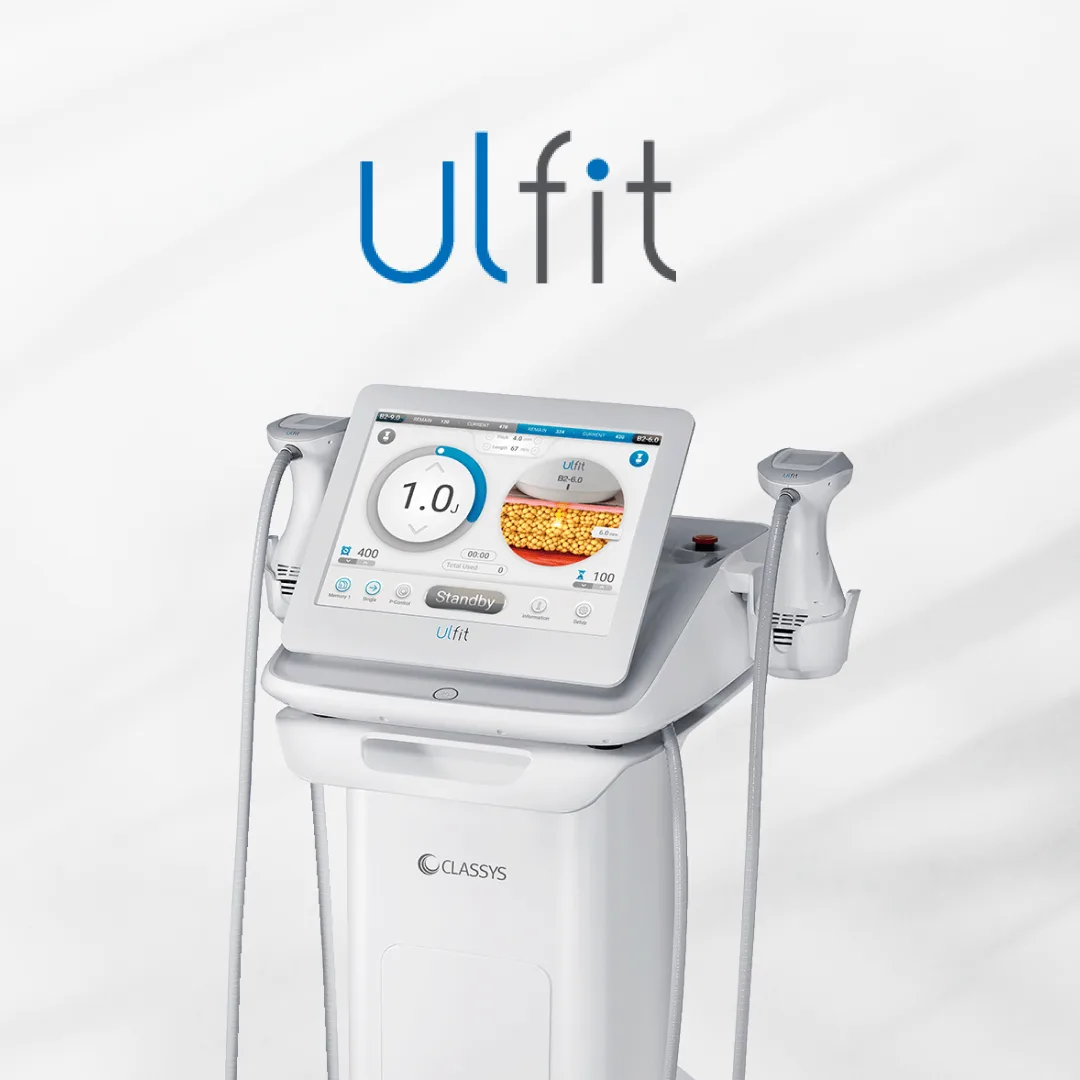
Body-line focused-ultrasound guide
ULFIT is a focused-ultrasound (HIFU) system from the Korean manufacturer CLASSYS, approved in Korea as a focused ultrasound stimulator system under item approval number 17-256, with an intended use limited to brow lifting and to improving the elasticity of skin and subcutaneous tissue on the face and on the abdomen and thighs.
ULFIT is a focused-ultrasound device built by CLASSYS INC, a Korean manufacturer, and its own product material gives the operating frequency as 2 MHz. HIFU here means high intensity focused ultrasound: energy is brought to a focal point below the skin surface rather than spread across it. In Korean booking menus it sits in the body-line category and is sold by shot count, so the line you book names a quantity of pulses while the manufacturer material names a device, a frequency and a set of cartridges. Those are two different kinds of information, and only the second one tells you what the machine is.
Sources: Classys — ULFIT official product pageClassys Korea — ULFIT, MFDS approval and intended use
Less than the word “body contouring” usually suggests. The Korean approval lists it as a focused ultrasound stimulator system under item approval number 17-256, and the intended-use wording is built around coagulating tissue: for brow lifting with the F7-1.5, F7-3.0 and F4-4.5 cartridges, and for improving the elasticity of skin and subcutaneous tissue on the face — specifically both cheeks — with LMF1, LMF3 and LMF4, and on the abdomen and thighs with B2-3.0, B2-6.0 and B2-9.0. Elasticity improvement is the claim that was approved. Fat removal, a promised change in circumference, and weight are not part of that wording, and nothing on this page extends it.
Sources: Classys Korea — ULFIT, MFDS approval and intended use
Because the approved wording pairs each cartridge group with its own area. Brow work is tied to cartridges numbered 1.5 to 4.5, the face cartridges are a separate LMF series for both cheeks, and abdomen and thigh work is tied to the B2 series at 3.0, 6.0 and 9.0. A number in a cartridge name is a working depth, and depth is what decides whether energy lands in a layer that belongs to a brow or to an abdomen. One practical caution for a booking made in Korea: the manufacturer’s English-language product material also shows a B2-13.0 body cartridge, but the Korean approval wording does not include it, so ask which cartridge is planned by name rather than assuming the full international lineup.
Sources: Classys Korea — ULFIT, MFDS approval and intended useClassys — ULFIT official product page
No United States clearance is claimed on this page, because none could be found under this device name. The regulatory category itself exists in the United States: the FDA has a Class II special controls guidance for focused ultrasound stimulator systems intended for aesthetic use, under 21 CFR 878.4590 and product code OHV. A direct search of the FDA’s own device database returned four clearances held by CLASSYS Inc, all of them under other product names, and no entry under the ULFIT name. A clearance granted to a different product is evidence about that product only, so it is not repeated here as if it belonged to this one. If a marketing line tells you otherwise, the fair question is which submission number it refers to.
Sources: FDA — focused ultrasound stimulator system for aesthetic use, Class II special controls guidance
One shot is one focal exposure, not a fixed dose. The FDA guidance for this device category describes the unit as a treatment zone of roughly one cubic millimetre formed by an exposure of about 10 to 100 milliseconds. What the guidance deliberately does not do is fix an output level, a focal depth or the spacing between shots — those are set by the device and the operator. The consequence is direct: 500 shots on one system at one setting and 500 shots on another are not the same amount of energy, are not necessarily over the same area, and cannot be added up across devices as if they were a common currency.
Sources: FDA — focused ultrasound stimulator system for aesthetic use, Class II special controls guidance
The published body of work is about HIFU as a category, and this device is not the subject of it. A 2025 systematic review covering January 2010 to October 2024 pooled 45 clinical trials and cohort studies; it reports skin laxity improvement of 18 to 30 per cent, body circumference reduction of 2.5 to 4.5 cm, and adverse events in under 5 per cent of cases, mostly transient erythema and oedema. The same review is graded Level of Evidence 3, and its authors state plainly that treatment protocols are not standardised and that long-term efficacy data are lacking. No randomised controlled trial or systematic review of ULFIT itself was identified for this page, so those pooled figures describe a family of devices and settings rather than an expected result from this one.
Sources: Aesthet Surg J 2025;45(7):690-698 — systematic review of HIFU
The result split by dose, which is the part worth carrying into a consultation. A randomised sham-controlled trial published in 2011 enrolled adults with at least 2.5 cm of abdominal subcutaneous fat into three arms — 47 J/cm, 59 J/cm and a 0 J/cm sham — and followed them for 12 weeks. In the intention-to-treat analysis the 59 J/cm arm showed a waist circumference reduction of 2.44 cm (p=0.01), while the 47 J/cm arm showed 2.06 cm and did not reach statistical significance (p=0.13). That trial used a different device, so it is not a ULFIT result and the numbers are not a target to quote back. What transfers is the principle that energy delivered, not the label on the treatment, is what the comparison turned on.
Sources: Plast Reconstr Surg 2011;128(1):253-262 — sham-controlled body HIFU RCT
The published evidence does not settle a duration for this device specifically. The 2025 systematic review pooling 45 HIFU studies is graded Level of Evidence 3, and its own authors state that treatment protocols are not standardised and that long-term efficacy data are lacking; the one randomised sham-controlled trial cited on this page — a different device — followed participants for 12 weeks only. The FDA’s page on non-invasive body contouring states, for this whole device category, that results may be temporary and that more than one treatment may be needed. What is more likely to decide how long a change holds is the area and cartridge treated, how much tissue was coagulated, and individual tissue response, none of which is fixed by a shot count. At consultation, ask how many sessions are being proposed, at what interval, and whether a maintenance session is already built into that plan.
Sources: Aesthet Surg J 2025;45(7):690-698 — systematic review of HIFUPlast Reconstr Surg 2011;128(1):253-262 — sham-controlled body HIFU RCTFDA — non-invasive body contouring technologies
Enough to be worth reading before booking. The FDA’s page on non-invasive body contouring lists pain and discomfort, redness, swelling, blistering, burns and nerve damage among the risks, and states that results may be temporary and that more than one treatment may be needed. A 2025 analysis of HIFU adverse events drew on 19 publications covering 506 patients plus 106 reports in the FDA’s MAUDE database: serious events were rare in the published literature, with one case of subcutaneous atrophy, whereas the most frequent categories in MAUDE were fat atrophy, neurological sequelae including nerve injury, localised numbness, paraesthesia and eyelid ptosis, and scarring. MAUDE reports are collected at product-code level and the brands behind them are mostly other systems, so this is not an adverse-event rate for ULFIT. It is a list of what gets reported, which is what you use to frame the question.
Sources: FDA — non-invasive body contouring technologiesDermatol Surg 2025;51(4):424-429 — HIFU adverse events, literature and FDA MAUDE
The goal in the approved wording is tissue elasticity, not the amount of fat you carry. The Korean intended use for the body cartridges is improving the elasticity of skin and subcutaneous tissue on the abdomen and thighs, and the FDA states for this whole category that non-invasive body contouring does not treat obesity and will not result in weight loss. Those two statements point the same way: a session is planned around an area and a tissue layer, not around a number on a scale, and it does not stand in for a surgical fat-removal procedure. If your goal is weight change, say so at the consultation, because that is a different clinical conversation and none of the sources cited here support treating this as a weight-management tool.
Sources: Classys Korea — ULFIT, MFDS approval and intended useFDA — non-invasive body contouring technologies
Settle the plan before the number. Ask which device is in the room, which cartridge is planned for which area and why, how the shots are distributed across that area, how many sessions are proposed and at what interval, who operates the device, and what happens to remaining sessions if you leave the country. Then disclose what only you know: pregnancy or breastfeeding, implanted electronic devices such as a pacemaker, metal or implants near the planned area, recent surgery or energy-based treatment on it, active skin disease or infection over it, bleeding or healing problems, and the medicines you take. The sources cited here publish no patient-facing eligibility list, so that judgement belongs to the treating clinician. Afterwards, contact the clinic promptly for blistering or a suspected burn, pain that keeps increasing, numbness or altered sensation that persists, spreading redness or warmth, or an unexpected dent in the contour.
Sources: FDA — non-invasive body contouring technologiesDermatol Surg 2025;51(4):424-429 — HIFU adverse events, literature and FDA MAUDE
The Korean approval wording ties cartridge groups to areas, which makes the cartridge the most useful thing to ask about. Use this table to check what a quote has actually specified — the rows are areas in the approved wording, not tiers of one treatment.
| Cartridge group | Area in the Korean approved wording | Confirm before comparing two quotes |
|---|---|---|
| F7-1.5, F7-3.0, F4-4.5 | Brow lifting | That the plan really is a brow plan, and which of the three depths is intended |
| LMF1, LMF3, LMF4 | Face — both cheeks — elasticity of skin and subcutaneous tissue | That a face quote is not being compared against a body quote by shot count alone |
| B2-3.0, B2-6.0, B2-9.0 | Abdomen and thighs — elasticity of skin and subcutaneous tissue | Which depth is planned, over how large an area, and that the goal stated is elasticity rather than fat removal |
| A menu line that names only a shot count | No area is defined by a number on its own | Which cartridge, which area, how many sessions, and what the count covers |
This table maps the approved intended use to consultation questions. It is not a ranking, not an efficacy comparison against other systems, and not a basis for treating equal shot counts on different devices as equivalent treatments. The manufacturer’s international material also shows a B2-13.0 cartridge, which does not appear in the Korean approval wording.
Sources: Classys Korea — ULFIT, MFDS approval and intended useFDA — focused ultrasound stimulator system for aesthetic use, Class II special controls guidance
Care is provided by the medical team at the branch you select. These clinicians lead the three branches linked from this guide; confirm the doctor assigned to your visit with that branch.
Chief MD, Gangnam
The trust our patients have placed in this clinic was built on conviction and principle. We intend to hold to both, unchanged, through the next hundred years.

Chief MD, Myeongdong
I want to be thinking about how the patient feels right up to the last moment of the procedure.

Chief MD, Hongdae
I will give my best with the attentiveness to catch even the smallest change.
Listed branch medical team — not a medical-review byline for this article.
ULFIT is a focused-ultrasound device from CLASSYS INC, a Korean medical aesthetic device manufacturer, running at 2 MHz. HIFU stands for high intensity focused ultrasound, meaning the energy is concentrated at a focal point under the skin rather than spread over the surface. The name is a product name, not a category, so a menu that says only “body ultrasound” has not yet told you which machine will be used.
A number of focal pulses, which is a count rather than a stated quantity of energy. The FDA guidance for this device category describes one shot as a treatment zone of about one cubic millimetre created by an exposure of roughly 10 to 100 milliseconds, and it does not fix output, depth or spacing. So the count tells you how many pulses are included and nothing about how strong each one is or how much of your body they will cover — both of which have to be asked separately.
It is being focused to a point deep enough to coagulate tissue at that depth, which is how the Korean approval wording describes the action. The approved purpose that follows from it is tissue elasticity improvement on the listed areas, plus brow lifting with the shallower cartridges. Nothing in the sources cited here states how much change an individual will see or on what timeline, so treat the expected course as a question for the clinician rather than something the technology settles in advance.
No — the cartridge changes, and with it the depth and the area. In the Korean approval wording the face cartridges form the LMF series for both cheeks and the brow cartridges run from 1.5 to 4.5, while abdomen and thigh work uses the B2 series at 3.0, 6.0 and 9.0. Because a body cartridge works at a depth a facial cartridge does not reach, a face quote and a body quote describe different procedures even when both are labelled HIFU and priced by shots.
They are different energy platforms, and, just as importantly, they are quoted in different units. HIFU is sold here as a count of focal shots; microwave and RF body systems are usually quoted per applicator placement, per pass or in joules per treatment zone, so the totals on two quotes are not the same kind of number. None of the sources cited on this page runs a head-to-head trial between ULFIT and a named microwave or RF device, so this page cannot tell you which suits your concern — that is what the assessment of your area is for.
Not necessarily, and usually not. The FDA guidance sets no fixed output, focal depth or shot spacing for this category, so the energy behind one shot varies by device and by setting. Two quotes only become comparable once you know the device name, the cartridge, the area being covered, how many sessions are included and who operates it. Ask for those in writing, and treat a bare shot count as the least informative part of the quote.
Sensation varies by person, by depth and by the energy used, which is why settings are adjusted during the session. The FDA lists pain and discomfort among the risks of non-invasive body contouring generally, alongside redness and swelling, and a 2025 review of HIFU adverse events found transient erythema and oedema to be the common findings in the published literature. Say so during treatment if one area is hard to tolerate, and ask beforehand how energy and shot distribution are adapted to sensitivity.
Plan for the possibility of short-lived reactions rather than assuming none. The pooled systematic review reports adverse events in under 5 per cent of cases, most of them transient redness and swelling, and the FDA category page lists redness, swelling and discomfort among expected risks. Because these figures come from mixed devices and protocols, they are not a schedule for your recovery. If you are travelling, agree on aftercare and a contact route before you fly home.
No source cited here publishes a fixed number or interval for this device, so it is decided by the treating clinician after assessment. The FDA notes for this whole category that results may be temporary and that more than one treatment may be needed, and the systematic review states that protocols are not standardised across the published work. What that means practically is that a package count is a commercial unit, not a clinical schedule — ask when a review visit is suggested and what will be reassessed then.
The FDA lists pain, redness, swelling, blistering, burns and nerve damage as risks of non-invasive body contouring. A 2025 analysis combining 19 publications on 506 patients with 106 FDA MAUDE reports found serious events rare in the literature — one case of subcutaneous atrophy — while the most frequent MAUDE categories were fat atrophy, neurological sequelae such as nerve injury, localised numbness, paraesthesia and eyelid ptosis, and scarring. MAUDE is collected by product code and the brands behind those reports are mostly other systems, so this is not a rate for ULFIT; it is the set of outcomes worth asking your clinician about.
Anyone whose history could affect healing, sensation or tissue condition in the planned area. The sources cited here publish no device-specific contraindication list, so the practical approach is full disclosure: pregnancy or breastfeeding, implanted electronic devices, metal or implants near the area, recent surgery or energy-based treatment on it, active skin disease or infection, bleeding or healing disorders, and current medicines. The clinician decides suitability from that plus the assessment, not from the device specification.
What can be stated is the Korean position: it holds a Korean approval as a focused ultrasound stimulator system under item approval number 17-256, with an intended use covering brow lifting and elasticity improvement on the face and on the abdomen and thighs. A search of the FDA’s device database found no listing under the ULFIT name, so no United States clearance is claimed here; four clearances held by CLASSYS Inc appear under other product names and are not evidence about this device. Registration is decided country by country, so check your own regulator rather than assuming a Korean approval transfers.
Compare the plan, not the headline number. Write down for each quote the device name, the cartridge and depth, the exact area covered, the number of shots and how they are distributed, the number of sessions and the interval, who performs the treatment and what aftercare or follow-up is included. Because a shot is not a standardised amount of energy across devices, a lower or higher count on its own tells you nothing about what you are receiving — the specification is where the difference actually lives.
Suitability is decided at the consultation from the area and the concern being assessed, within the approved intended use. That intended use is elasticity improvement of skin and subcutaneous tissue on the listed areas, plus brow lifting — so someone whose goal is weight change or fat removal is asking about a different category of treatment, and the FDA is explicit that non-invasive body contouring does not treat obesity and will not result in weight loss. Bring your goal in plain words to the consultation and ask whether this intended use matches it.
We started in Gangnam in 2006 and the network now runs 17 branches across Korea. The line we work to is skin transformation woven into everyday life — care you can keep up with, rather than one dramatic change.
Free Consultation
There is no inquiry form on this page. Once you have picked a branch above, open that branch’s site or the official reservation center and choose a time yourself.